A Policy and Legal Roadblock to Net-Zero: Rethinking investment agreements for climate action
As leaders set global climate priorities in the 30th United Nations Climate Change Conference (COP 30) in Bélem, the widening investment gap needed to meet climate goals underscores the urgency of accelerating and deepening reforms to the international investment architecture, which is built on thousands of bilateral and regional investment agreements. To reach net-zero emissions by 2050, annual clean energy investment worldwide needs to more than triple to USD 4 trillion by 2030. However, according to UNCTAD, investment fell by 11% in 2024, marking the second straight year of decline.
The international investment framework needs to be modernized to accelerate clean energy investments without hindering national climate measures. As countries try to phase out their reliance on fossil fuels, oil and gas firms might use these treaties to challenge certain policy changes, as IISD notes in a recent report. Examples include ongoing coal phase-out cases against Australia, Germany and the Netherlands.
The current international investment framework was designed for a different era—one in which climate considerations played little to no role—and today it can constrain countries’ ability to advance effective climate action.
IIAs, which govern the treatment of cross-border investment, form a sprawling regime of more than 2,600 treaties currently in force. Most of these agreements were negotiated over three decades ago, with minimal attention to environmental protection or the imperative to channel investment toward sustainable development. As a result, the regime often lags behind the needs of countries seeking to align investment policy with their climate commitments.
They generally contain protection standards for investors and investments, and grant broad access to ISDS in the form of binding international arbitration available directly to investors. These treaties were often concluded with little or no attention to host states’ regulatory flexibility for environmental protection and climate action. Outdated agreements from the 1990s and 2000s continue to dominate the regime and are behind almost all publicly known ISDS cases with significant financial consequences, according to UNCTAD data.
Newer agreements signed since 2010 fare relatively better in safeguarding states’ right to regulate and in incorporating specific provisions on the protection of the environment, climate action, and sustainable development. However, both old and most recent IIAs continue to lack targeted provisions aimed at effectively supporting climate action. Only a handful of recent IIAs are beginning to distinguish between low-carbon and high-carbon investments or include provisions to effectively support climate action.
Fossil Fuel, Renewable Energy and Critical Minerals Cases—A risk for climate action policies
The current IIA regime can constrain states when implementing measures to combat climate change. The ISDS mechanism in IIAs was designed to protect foreign investors from “excessive” government action. But it also limits countries’ ability to regulate, even when pursuing legitimate public policy objectives, such as climate action. And the financial consequences of ISDS disputes may be significant: in the past decade, successful ISDS claimants were awarded about $230 million on average. At the same time, the average amount claimed rose to almost $1 billion.
ISDS cases based on IIAs can create tensions with climate action, the implementation of the sustainable energy transition and national critical minerals strategies, creating additional challenges and raising the cost for governments trying to fulfill their international obligations on climate.
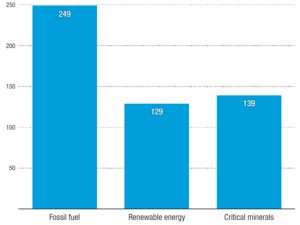
In the period between 1987 and 2024, investors filed at least 249 treaty-based ISDS cases related to fossil fuel activities, making the sector the most litigious within the ISDS system, and 129 cases concerning renewable energy investments (Figure 1). At least 139 ISDS cases—about 10% of all cases—related to different categories of critical minerals, including 51 cases relating to critical minerals required for the energy transition. For the year 2024, the share of new disputes arising from mining, oil, gas, and coal extraction doubled.
The volume of past ISDS cases, as well as several high-profile disputes related to fossil fuel activities, renewable energy, and critical minerals investments, illustrate the risks of potential future investor claims challenging fossil fuel phase-outs and changes to policy and legal frameworks for renewable energy and critical minerals.
Figure 1. IIA-based ISDS cases related to economic activities relevant to climate action
Cumulative number of cases (1987–2024)
Source: UNCTAD, 2025.
Climate Action Calls for Faster and Comprehensive Investment Treaty Reforms
While IIA reform is underway in many countries, a lot remains to be done to move from a framework that limits the capacity of countries in implementing measures needed for climate action to one that effectively promotes sustainable investments. In view of the narrow time window available to keep warming within 1.5°C, and the unprecedented aggregate scale of potential investor-state claims that may be associated with climate measures such as fossil fuels phase-outs, already at the 2022 COP, the Sharm El Sheikh Guidebook for Just Financing called for states to both deepen and accelerate reform processes.
Intergovernmental and multistakeholder dialogue can play a role in identifying and devising IIAs that promote and facilitate sustainable investments in support of climate action. Governments may wish to consider three approaches in parallel:
- making individual IIAs climate-responsive by, for example, excluding fossil fuel investments from treaty protection and incorporating provisions that actively promote and facilitate sustainable and responsible energy investment, including technology transfer and diffusion on mutually agreed terms.
- minimizing the risk of ISDS claims against climate action by safeguarding states’ right and duty to regulate for environmental protection by refining investment protection standards.
- prioritizing the reform of the IIA regime by addressing outdated agreements through renegotiation, amendment, or termination, pursued via multilateral, regional, and bilateral initiatives.
In its toolbox on IIAs and sustainable energy and climate-friendly investment, UNCTAD offers more specific policy options to transform the IIA regime for climate action.
Authors
Dafina Atanasova (PhD) is International Investment Law and Policy Expert, International Investment Agreements Section, Division on Investment and Enterprise, UNCTAD. Diana Rosert is Economic Affairs Officer, International Investment Agreements Section, Division on Investment and Enterprise, UNCTAD. Hamed El-Kady is Chief Coordinator of the International Investment Agreements Programme, UNCTAD, Division on Investment and Enterprise.
The authors’ contributions to this publication are undertaken in a personal capacity and do not represent the views of the UNCTAD Secretariat/UNCTAD International Investment Agreements Section.


