
Opportunities in Crises: The role of energy taxes and stimulus in shaping India's green recovery
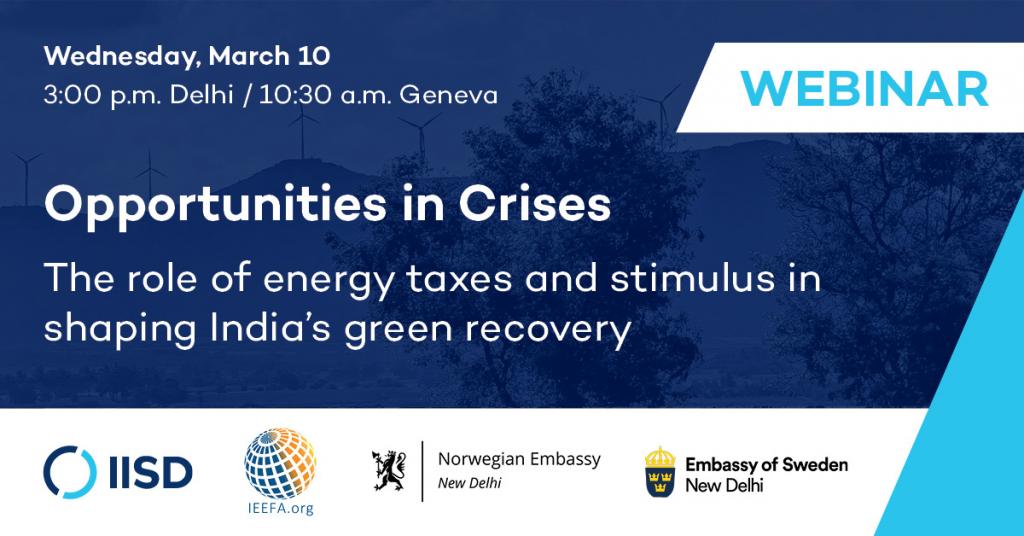
India is a leader among large emerging economies for its innovative use of fossil fuel taxes, such as the coal cess and excise taxes, to raise revenues and foster a clean energy transition. This combination of fossil fuel taxes and support for renewable energy characterizes both the Nordic and Indian approaches to the energy transition.
Nordic countries are internationally recognized for delivering strong economic growth with robust social and environmental policies. Since 2000, the Nordic economies grew 28%, while their carbon dioxide emissions fell by 18%. One of the secrets of their success in balancing these priorities has been the innovative use of energy taxation to recover from an economic crisis, such as the world is facing today.
This webinar, co-organized by IISD, IEEFA, the Royal Norwegian Embassy, New Delhi, and the Embassy of Sweden, New Delhi is unique in bringing together diverse perspectives and specific examples of green fiscal reforms and recovery strategies to inform decision-making by governments and offers valuable insights for researchers and policy experts.

Additional downloads
Upcoming events
IGF 22nd Annual General Meeting
The 22nd IGF AGM will be held under the theme of Trust in an Interdependent World: Advancing inclusion and resilience in mineral value chains.
Counting What Counts: Implementing beyond GDP metrics
This hybrid event will explore practical pathways for implementing Beyond GDP metrics at the national level.
2026 Investment Policy Forum
The 17th edition of IISD's Investment Policy Forum will take place from September 16 to 18, 2026, in Dar es Salaam, Tanzania.
Trade Policy in Support of Climate Change Adaptation: Sharing results from a research collaboration in Viet Nam and the Pacific
A webinar to help trade and climate policy-makers understand how trade policy can support climate change adaptation, drawing on new IISD research from Viet Nam and the Pacific.