
COP 30 Side Event | From Equality to Empowerment: Making the energy transition inclusive
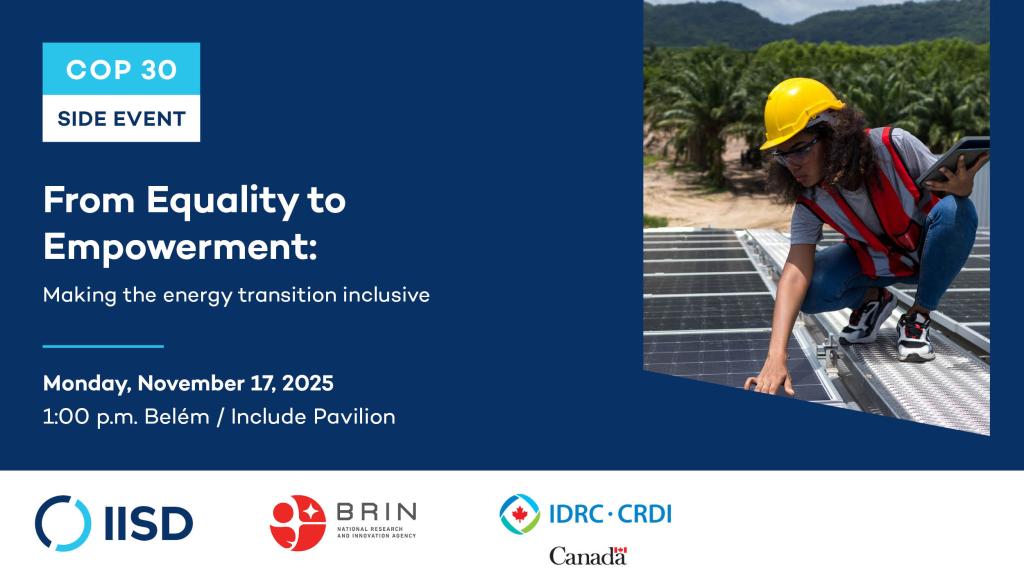
As countries accelerate the clean energy transition, there is growing recognition that energy policies often overlook the needs of women, youth, and marginalized communities. Without deliberate efforts to integrate social justice into energy policy design and implementation, the energy transition risks deepening inequality, including exclusion from access to energy, employment, and business opportunities.
Yet the energy transition also presents a real opportunity for transformative change through positive impacts on women, youth, and marginalized groups. Three key areas for this are clean cooking, solar irrigation, and just transition.
Globally, governments spend billions subsidizing liquefied petroleum gas (LPG), yet poor targeting leads to limited uptake of subsidized LPG by vulnerable households who continue to rely on biomass for cooking. In solar irrigation, government subsidy support is focused on individual solar pump ownership, which tends to exclude the poorest and women, who are not typically landowners. Lastly, falling demand for coal brings economic and social challenges for coal-producing economies. These shifts will have implications for women, informal workers, and other groups that are often underrepresented in traditional government consultation approaches. As governments shift public funds from fossil fuels to clean energy, emerging evidence suggests that energy policies can have more inclusive and sustainable outcomes.
The COP 30 side event will invite experts from the energy, gender, development, business, and government sectors to share experience, innovations, and research on gender equity and social inclusion in clean energy transitions, particularly across three themes of clean cooking, solar irrigation, and just transition. This hour-long event will bring together researchers and practitioners to demonstrate that energy policy can better reflect the needs of women, youth, and disadvantaged groups through evidence-based and locally informed solutions.
This event is co-organized by the International Institute for Sustainable Development, the International Development Research Centre, and the National Research and Innovation Agency.
Agenda
Welcome
Angie Dazé, Director, Gender Equality and Social Inclusion, International Institute for Sustainable Development
Keynote Addresses
Bhim Adhikari, Senior Program Specialist, International Development Research Centre
Franky Zamzani, Director, Climate Change Adaptation, Ministry of Environment, Republic of Indonesia
Christine Lins, Executive Director, Global Women's Network for the Energy Transition
Roundtable
Liane Schalatek, Director, Heinrich Böll Stiftung
Maxensius Sambodo, Senior Researcher, National Research and Innovation Agency
Shruti Sharma, Lead for Affordable Energy, International Institute for Sustainable Development
Melanie Chiponda, Shine Collaborative
Closing Summary
Upcoming events
Learnings from Implementing NbS for Adaptation in and around Protected Areas
A webinar exploring lessons learned from implementing nature-based solutions for climate adaptation and resilience in and around protected areas in Angola, Belize, Fiji, Namibia, Uganda, Zambia and Zimbabwe.
IGF 22nd Annual General Meeting
The 22nd IGF AGM will be held under the theme of Trust in an Interdependent World: Advancing inclusion and resilience in mineral value chains.
2026 Investment Policy Forum
The 17th edition of IISD's Investment Policy Forum will take place from September 16 to 18, 2026, in Dar es Salaam, Tanzania.
Inside the World Trade Organization Public Forum 2026
The WTO Public Forum, taking place from September 15 to 17, 2026, explores services trade as a driver for development under the theme "Powering the Future", with IISD co-organizing for the first time to bring sustainability to the heart of the conversations.