Photography January 14, 2026
This Is What Happens When Canadian and Rwandan Scientists Team up to Monitor the Health of Rivers in East Africa
By Sumeep Bath, Editorial and Communications Manager
When it comes to identifying the threats to our freshwater supplies, problems and solutions are always better shared.
That is why, last year, we hopped on a plane and visited Akagera National Park—Central Africa’s largest protected wetland—in Eastern Rwanda.
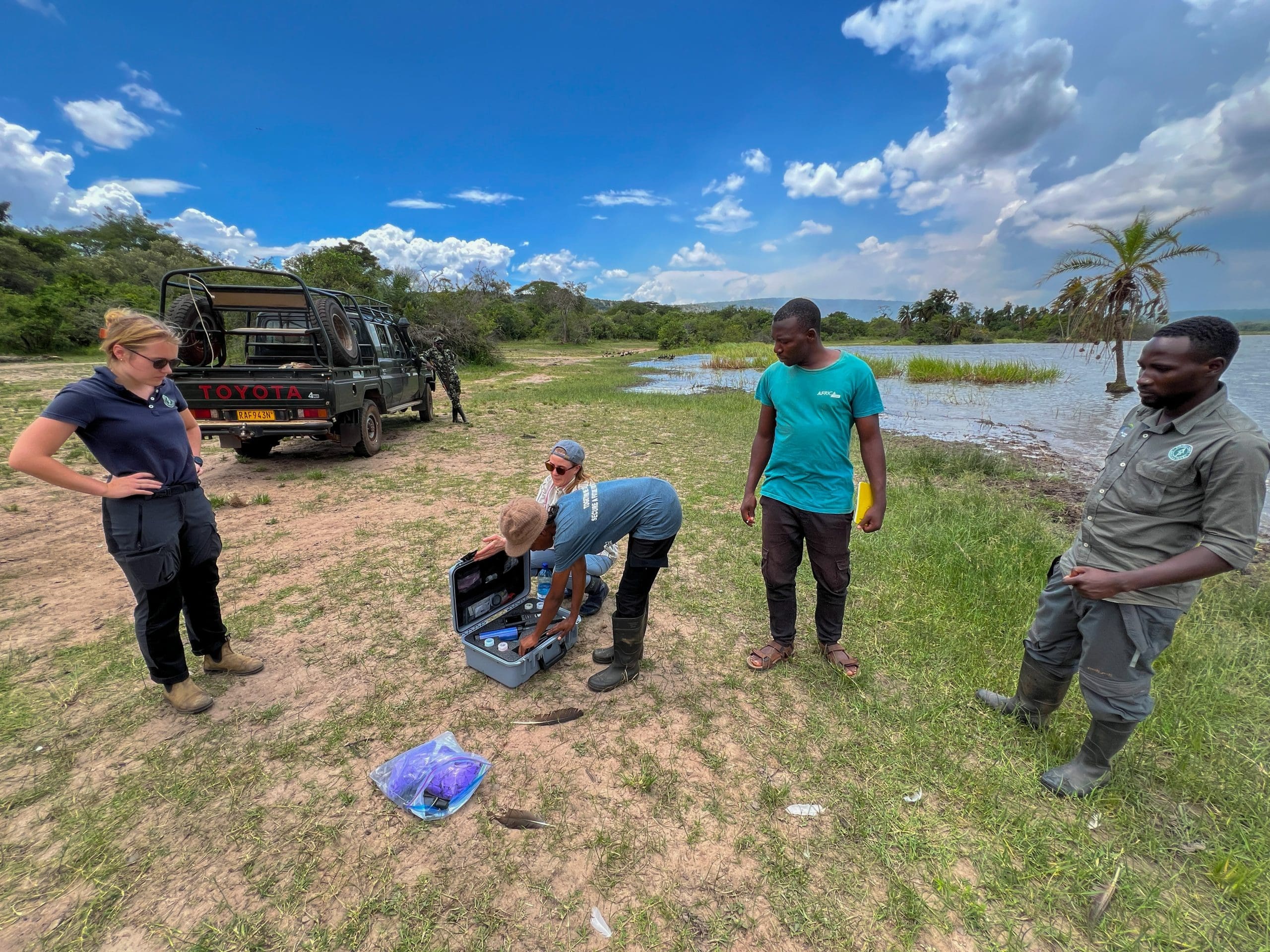
While there, we teamed up with Rwandan scientists to tour and monitor the park’s lakes and rivers—for everything from microplastics to temperature, pH, salinity, and oxygen—and to trade our respective sampling techniques and latest research on freshwater health.
And it’s certainly not the only work we do on East African waters. It fits into an ever-expanding pattern of work that includes building the next generation of women freshwater scientists and connecting with experts across the seven African Great Lakes.
But, for now, this is what we got up to in Akagera, in images…
(Photos by Luke Mahler)
The team checks the equipment twice before heading out for a day of sampling on the rivers in Akagera National Park.
A friendly, friendly hippo comes over to say hi in Akagera National Park.

Emerance Tuyipfukamire shows us what the microplastics sample looks like once collected. These particles cannot be seen with the naked eye, so it does look a little like a bag of water. Once taken back to the laboratory, the samples are digested to remove organic matter, and the microplastics are counted and characterized under a microscope.

Desiree Langenfeld and Simon Muhayimana team up to filter lake water through a sieve to collect microplastics for counting back at the lab.

A baboon watches over us and supervises our monitoring techniques in Akagera National Park. Full scores, across the board…

Desiree Langenfeld, Chelsea Rochman, and Emma Evers discuss the day’s plan of action before heading off to sample.

A village weaver (Ploceus cucullatus) works on a new nest to impress the ladies. You can tell it’s new from how green the grass is; meanwhile, his older efforts have yellowed and dried out.

A giraffe temporarily joins our monitoring team as we tour Akagera National Park. Total team player; would definitely rehire.

Desiree Langenfeld, Chelsea Rochman, and Adrien Nkundimana sample microplastics from a central location on Lake Ihema. We also collected samples from the Kagera River inflow and the shoreline near a ranger station to get a basic idea of how microplastics could be distributed across the lake.

A pair of grey crowned cranes lives at the staff accommodations in Akagera National Park. These cranes are an endangered species and were reintroduced to Akagera Park in the 2010s. They have a pretty haunting cry, which we woke up to every morning at the park. Prettiest version of a rooster.

Vince Palace collects a very small volume of water from a pond while Simon Muhayimana places the YSI probe to collect in situ temperature, pH, salinity, and oxygen information. This tiny tube of water will be used to assess what pesticides and herbicides might be contaminating this water.

A male impala shows off his horns, but could never distract us from our task at hand.

Checking into our accommodations for the next week while making friends with the in-house chef. The park headquarters has everything you could need, from a café to accommodations…

Terrapin! Terrapin! Terrapin!

Chelsea Rochman and Emerance Tuyipfukamire work together to collect microplastics from downstream of one of the many small agricultural dams west of the park.

It’s not all hard work. We take a moment to breathe in the flora and fauna of Akagera National Park. This herd of Cape buffalo was unperturbed by our touristic tendencies.

This hippo, however, is clearly tired of all our monitoring shenanigans. And is not afraid to show it.

Teamwork makes the dream work. Collecting more microplastics samples from a dam in a village. We’re collecting from outside the park to see if the wetlands within the park are performing any sort of filtration and settling effects to clean the river as it passes through.

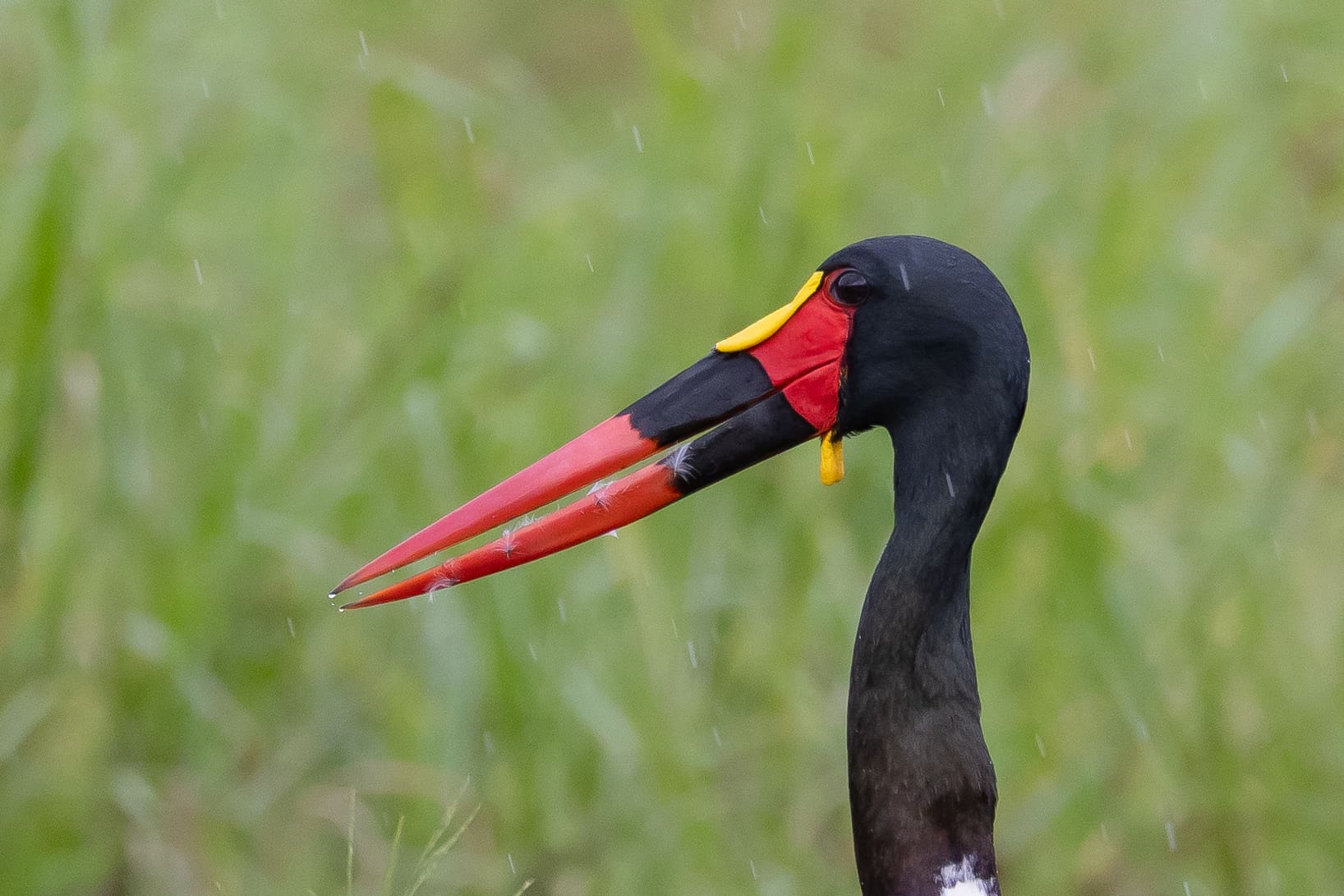
A saddlebill (or saddle-billed stork) eyes us through the rain. These birds are primarily piscivorous but will opportunistically eat other prey, as evidenced by the feathers on this one’s beak, leftover from a recent snack.
Desiree Langenfeld notes macroplastic litter in our sampling area during a monitoring day.

Two topi (a species of antelope) watch us pass by in our safari vehicle.

Enjoying a brewski or two after a long day sampling in the field. See you tomorrow!
