
The True Cost of Coal and Renewables in Indonesia
Indonesia is facing an energy crunch as demand for electricity rises across the country. The country is one of the world’s largest coal producers, and is developing plans for an additional 35 gigawatts (GW) of new coal-fired power stations. Proponents of the development claim that coal is the cheapest source of energy available. Is this really true?
Indonesia is facing an energy crunch as demand for electricity rises across the country. The country is one of the world’s largest coal producers, and is developing plans for an additional 35 gigawatts (GW) of new coal-fired power stations. Proponents of the development claim that coal is the cheapest source of energy available.
Is this really true?
IISD’s Global Subsidies Initiative (GSI) analyzed the costs of coal compared to renewable energy and found that coal use actually brings with it additional costs that are not traditionally taken into account:
- First, coal producers often receive subsidies. The GSI identified 15 subsidies worth at least USD 644 million in 2015.
- Second, air pollution due to coal use is estimated to cause more than 6,000 deaths annually.
- Finally, greenhouse gas emissions from coal threaten to undermine targets under the Paris Agreement on Climate Change and contribute to dangerous levels of global warming. If we monetize these impacts, the total cost of coal is estimated to be around USD 11 cents per kilowatt hour (kWh), more than double the cost of competing renewable energy based on recent global renewable auction results.
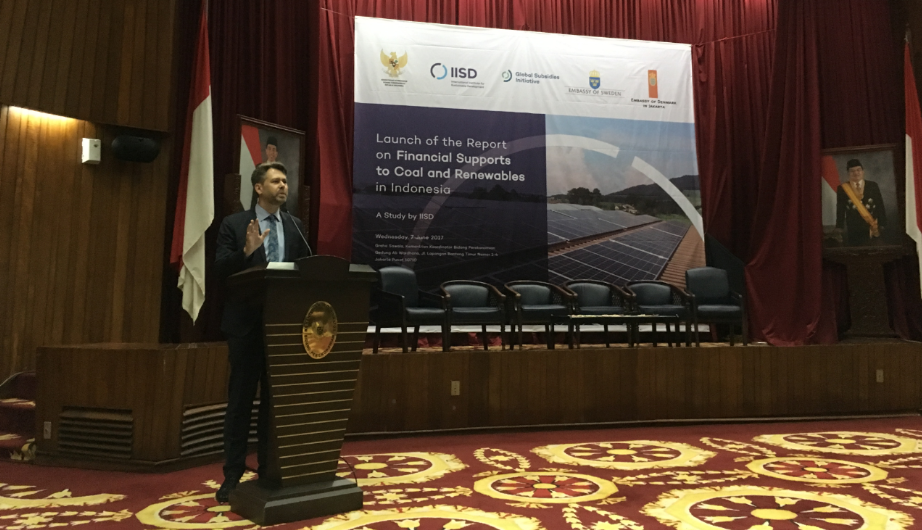
The findings were recently published in a report launched in Jakarta with the collaboration of the Coordinating Ministry for Economic Affairs and the support of the Danish Embassy and the Swedish Embassy in Jakarta.
Speaking at that event, the Ambassador of Denmark to Indonesia, Casper Klynge, said:
“Indonesia is facing difficult challenges ahead in achieving targets in the electricity sector, including boosting electricity generation and distribution. Costs of electricity generation from different sources, including costs of externalities, should be fully accounted for and factored into economic models in order to arrive at the true cost of electricity. Denmark stands ready to share its lessons learned in the electricity sector with Indonesia and to assist Indonesia in achieving a more sustainable energy future without jeopardising energy security.”
The findings are supported by the recent falls in solar PV prices that have led India to cancel new coal capacity, in addition to rising concern about the impacts of coal use on air pollution. For example, in China this concern led to a moratorium on new coal plants in 28 out of 31 provinces. With the tide turning against coal across the world, there is real concern that investments made today could soon be impossible to operate on environmental, public health and cost grounds, leaving a legacy of stranded power stations as the last monuments to the age of coal.
The evidence is starting to mount that the removal of subsidies to coal and a general shift to a renewable energy-focused energy policy would reduce risk and create a more sustainable future across Indonesia.
You might also be interested in
Indonesia spent IDR 713.5 trillion on energy subsidies in 2024
Indonesia needs a gradual, transparent reallocation of government spending from fossil fuels to clean energy.
Indonesia’s Energy Support Measures
In 2024, Indonesia spent IDR 713.5 trillion on energy subsidies, with nearly 90% of that supporting fossil fuels.
Indonesia’s Shift to Induction Cooking Could Ease LPG Subsidy Costs While Improving Health
New research finds Indonesia could save up to IDR 12 trillion a year, cut reliance on imported fuel, improve public health, and unlock long-term savings by accelerating a shift from subsidized LPG to electric induction cooking.
Indonesia’s Next Cooking Transition
This report compares three alternatives—induction stoves, dimethyl ether (DME), and city gas—and finds that induction stoves are the most practical and viable option to support Indonesia’s shift to cleaner, non-fossil cooking.