Winnipeggers’ Physical Activity Dips Below National Average
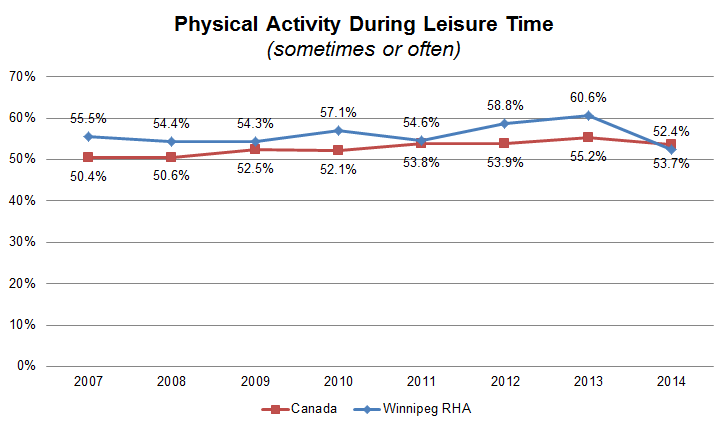
The latest report from our Peg project reveals that 52.4 per cent of Winnipeggers are ‘sometimes’ or ‘often’ physically active during their leisure time—a figure lower than the national average of 53.7 per cent.
Summer is winding down and Winnipeggers are gearing up to go back to school and begin recreational programming for the fall. What does Peg tells us about how active Winnipeggers are compared to Canadians overall?
52.4 per cent of Winnipeggers are ‘sometimes’ or ‘often’ physically active during their leisure time—a figure lower than the national average of 53.7 per cent.
Peg tells us…
- In 2014, 52.4 per cent of Winnipeggers were sometimes or often physically active during their leisure time, down slightly from 54.3 per cent five years earlier.
- For the first time in almost ten years, fewer Winnipeggers were physically active in 2014 than the national average (52.4 per cent of Winnipeggers vs. 53.7 per cent of Canadians).
Why does this matter?
- Regular physical activity has many benefits. It helps growth and development, prevents chronic diseases, strengthens muscles, increases energy levels, decreases stress levels and helps keep people more independent as they age (PHAC, 2016).
Definitions:
- Respondents are classified as active, moderately active or inactive based on an index of average daily physical activity over the past 3 months.
- More detail and source data for the above facts available at: http://www.mypeg.ca/explorer/WellBeing/Health/Activeleisuretime/
Source of the data:
- Peg’s data for the Active Leisure Time indicator is provided by Statistics Canada.
Media inquiries:
For interviews on Peg, the data, or to be connected with organizations making a difference in the community, please contact:
Sumeep Bath, Media and Communications Officer
International Institute for Sustainable Development (IISD)
(204) 958-7700 ex. 740 | [email protected]
About us:
Peg (mypeg.ca) is a community indicator system that measures the health of our community year over year – in ways that count. Peg is led by two partnering organizations – the International Institute of Sustainable Development (IISD) and United Way of Winnipeg (UW).
Regularly, the team at Peg releases data and facts that help us understand our city better. This is one of those regular reports. Others can be found at http://www.mypeg.ca/blog.
Peg is the starting place for Winnipeg citizens, educators, policy makers, and many others to learn more about our city so we can lead change to create a better city for our children and their children. At Peg we can all learn how our lives, our neighbourhood and our city is changing – for the good and the bad. Learn more at www.mypeg.ca.
About IISD
The International Institute for Sustainable Development (IISD) is a globally recognized think tank with 3 decades of experience working to solve the world’s most pressing sustainable development challenges. We combine deep expertise in a wide range of issues with a collaborative approach to research, policy advice, and hands-on support to ensure these solutions are brought to life. Headquartered in Winnipeg, Manitoba, we are a diverse team of over 300 professionals working from offices in Canada, Switzerland, and other locations around the world.
You might also be interested in
From Voluntary to Binding
This report examines how sustainability standards and initiatives are integrated into public mining governance, from voluntary to mandatory use, with case studies from Brazil, Madagascar, and Sweden.
Why the Scope of Taxes Covered Will Determine the Success of the UN Framework Convention’s Services Protocol
This article analyzes the UNFCITC draft protocol on cross-border services and its ambitious proposal to cover digital service taxes and quasi-income levies.
A Turning Point for Digital Trade Policy
A report on the expiry of the World Trade Organization e-commerce moratorium at the Fourteenth Ministerial Conference, the unresolved questions of scope and definition, and what the emerging landscape of customs duties commitments means for developing economies.
IISD Submission to the Belém Mission to 1.5
This submission is made in response to the invitation from the United Nations Climate Change Conference (COP) 29, COP 30, and COP 31 Presidencies on the Belém Mission to 1.5.