Trump’s rejection of Paris Agreement is a call to action and resolve for us all
"U.S. President Donald Trump’s withdrawal from the Paris Agreement on climate change puts the United States at odds not just with the international community, but with overwhelming scientific evidence and the publicly expressed wishes of hundreds of American companies, from Apple to Exxon. U.S. President Donald Trump’s withdrawal from the Paris Agreement on climate change puts the United States at odds not just with the international community, but with overwhelming scientific evidence and the publicly expressed wishes of hundreds of American companies, from Apple to Exxon."
U.S. President Donald Trump’s withdrawal from the Paris Agreement on climate change puts the United States at odds not just with the international community, but with overwhelming scientific evidence and the publicly expressed wishes of hundreds of American companies, from Apple to Exxon.
Without the United States, the rest of the world will have a harder time meeting the Paris Agreement’s goal of preventing global temperatures from rising more than 2 degrees Celsius above pre-industrial levels. And the United States will miss out on the creation of more jobs and economic growth as well as reduced business risks.
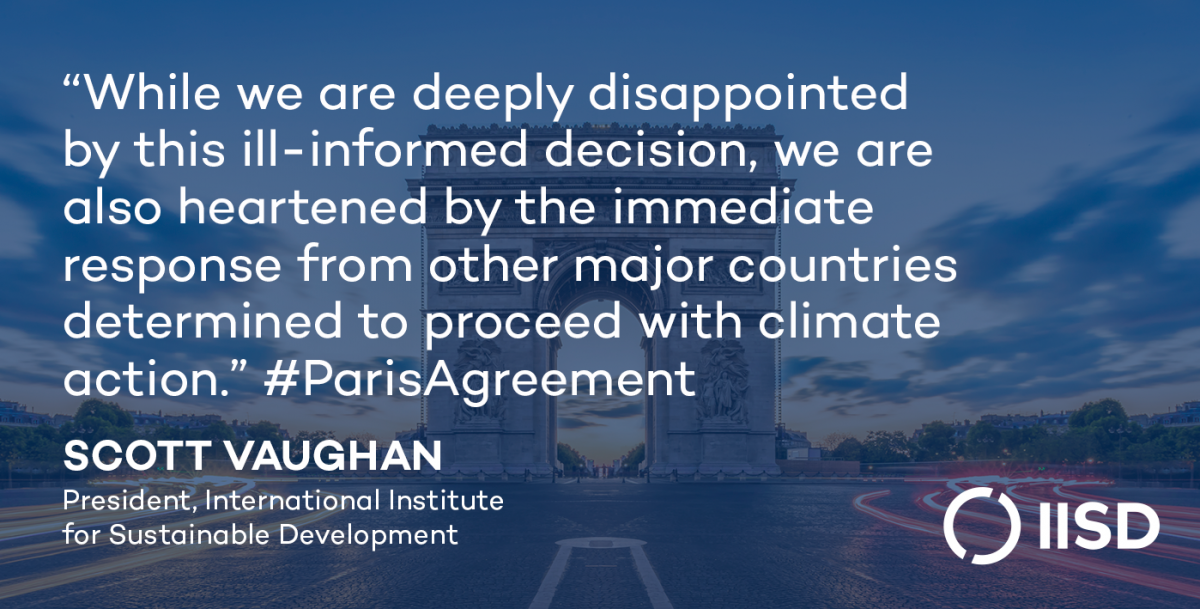
While we are deeply disappointed by this ill-informed decision, we are also heartened by the immediate response from other major countries determined to proceed with climate action. India, the European Union and China pledged to accelerate their efforts. Canada announced it will co-host a ministerial summit with China and the European Union in September to advance action on the Paris Agreement.
Even more importantly, new coalitions of states, cities and businesses within the United States have emerged in defiance of the president's decision.
Governors from California, New York and across the country declared they would work together to move ahead with climate action. Yesterday, 83 mayors signed a statement vowing to uphold the commitments to the goals enshrined in the Paris Agreement.
And finally, U.S. businesses have expressed their frustration and disappointment with the decision, but also stressed that it would have little impact on their own ongoing efforts. Brad Smith, CEO of Microsoft, said this about the Paris Agreement: "A global framework strengthens competitiveness for American businesses. It creates new markets for innovative clean technologies, from green power to smart grids to cloud-enabled solutions."
At IISD we will continue to work across the world and in the United States at every level of government to help implement climate action. We echo the words of the 83 U.S. mayors who committed to adopting and upholding the Paris Climate Agreement goals:
“The world cannot wait—and neither will we.”
About IISD
The International Institute for Sustainable Development (IISD) is a globally recognized think tank with 3 decades of experience working to solve the world’s most pressing sustainable development challenges. We combine deep expertise in a wide range of issues with a collaborative approach to research, policy advice, and hands-on support to ensure these solutions are brought to life. Headquartered in Winnipeg, Manitoba, we are a diverse team of over 300 professionals working from offices in Canada, Switzerland, and other locations around the world.
You might also be interested in
Clean Energy Support is Saving Major Energy Importers Billions
New analysis finds public support for renewables and electrification is reducing dependence on imported fossil fuels, strengthening resilience to price shocks, and lowering energy costs.
From Patchwork to Production
Canadian waters hold some of the world's most promising offshore wind resources, but incomplete and fragmented regulations threaten to leave that potential stranded. Getting the rules right is now a strategic imperative.
At Least Seven BRICS+ Nations Shift EV Support to Buses and Two-Wheelers
New analysis finds that at least seven BRICS+ countries—Brazil, China, Ethiopia, India, Indonesia, Malaysia, and Thailand—are directing electric (EV) support toward two- and three-wheelers, as well as public and shared transport.
Insights on Monitoring, Reporting, and Verification in Carbon Pricing
How governments can design monitoring, reporting, and verification systems that make carbon pricing credible, workable, and inclusive.