A historic day as Paris Climate Agreement crosses a critical threshold
The global commitment to slowing the pace of climate change culminated today with the European Parliament approving the ratification of the Paris climate agreement thereby enabling its entry into force this week.
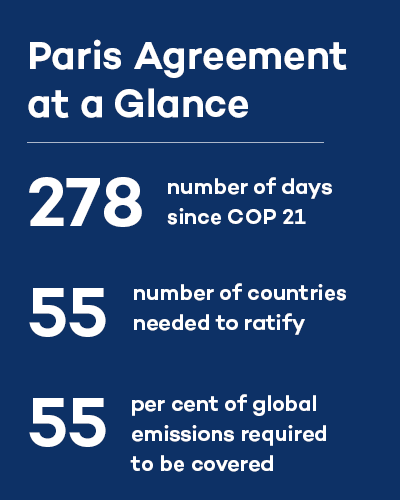
The historic agreement, adopted by 185 nations in the French capital last December, required ratification by 55 countries contributing to at least 55 per cent of global greenhouse emissions before coming into effect. With the European Union expected to deposit its ratification instruments on Friday, those thresholds will be crossed.
“Ratification of the Paris agreement has moved through national capitals with remarkable speed,” said Frédéric Gagnon-Lebrun, IISD’s program leader on climate change mitigation. “It’s a striking departure from past practice in international climate change negotiations and demonstrates the significant buy-in from countries that continues to build following the adoption of the agreement last December.”
 “The environment has not eclipsed the political primacy of jobs and the economy. What’s changed, however, is the mainstream understanding that these priorities are incompatible with catastrophic climate change,” said Gagnon-Lebrun.
Countries will turn to the task of developing the rulebook that will guide the implementation of the agreement when they gather for the UNFCCC’s Twenty-second Conference of the Parties (COP-22) in Marrakesh, Morocco, from 7-18 November. “With the Paris Agreement now into force, the Marrakesh conference will go down in history as the first meeting of the Parties to the Paris Agreement,” said Gagnon-Lebrun.
"The Paris Agreement is an important victory towards preventing the worst effects of climate change," said Anne Hammill, director of IISD's resilience program. "But in order to prepare for the climate change impacts that our greenhouse gas emissions to date will cause, we hope all countries take urgent action on the Paris agreement's call to engage in adaptation planning and implementation."
In parallel, all countries now need to diligently start the hard work of implementing the climate change plans presented ahead of COP-21 in Paris, known as Nationally Determined Contributions, as well as mechanisms to report back to the international community on progress made.
About IISD
The International Institute for Sustainable Development (IISD) is a globally recognized think tank with 3 decades of experience working to solve the world’s most pressing sustainable development challenges. We combine deep expertise in a wide range of issues with a collaborative approach to research, policy advice, and hands-on support to ensure these solutions are brought to life. Headquartered in Winnipeg, Manitoba, we are a diverse team of over 300 professionals working from offices in Canada, Switzerland, and other locations around the world.
You might also be interested in
From Patchwork to Production
Canadian waters hold some of the world's most promising offshore wind resources, but incomplete and fragmented regulations threaten to leave that potential stranded. Getting the rules right is now a strategic imperative.
At Least Seven BRICS+ Nations Shift EV Support to Buses and Two-Wheelers
New analysis finds that at least seven BRICS+ countries—Brazil, China, Ethiopia, India, Indonesia, Malaysia, and Thailand—are directing electric (EV) support toward two- and three-wheelers, as well as public and shared transport.
Insights on Monitoring, Reporting, and Verification in Carbon Pricing
How governments can design monitoring, reporting, and verification systems that make carbon pricing credible, workable, and inclusive.
August 2026 | Carbon Minefields Oil and Gas Exploration Monitor
When IISD launched Carbon Minefields, we aimed to make the continued expansion of oil and gas production more visible and measurable.