
The Adaptive Watershed: Training for watershed-based adaptation and management
When it comes to managing our watersheds in a way that is integrated and adaptive, practicioners have always encountered difficulties with implementation. It can be challenging to ensure a holistic approach that includes ecosystem, watershed, and adaptive management. This is why IISD's Water Program is facilitiating the process.
When it comes to managing our watersheds in a way that is integrated and adaptive, practitioners have always encountered difficulties with implementation.
It can be challenging to ensure a holistic approach that includes ecosystem, watershed, and adaptive management while being inclusive towards women and marginalized sectors of society.
The importance of the concepts is irrefutable; it's the implementation that remains complex and challenging.
This is why IISD's Water Program is facilitating the process.
Our Adaptive Watershed project provides practical implementation guidance on these interrelated areas of work through on-the-ground, strategic training aimed at local planners, decision makers, technicians, NGOs and others who might be engaged at various levels in decisions and tasks around land and water management, climate adaptation, conservation, community development etc.
The project focusses on engagement with watershed managers, including a three-day training for local decision makers. Training modules include building a clear understanding of ecosystems, ecosystem services, watershed stakeholder needs, climate change impacts, vulnerability and adaptation, as well as gender equity. Ultimately, the goal is developing management systems that take into account global sustainable development goals and other national priorities.
Participants will return to their communities equipped with knowledge and skills to better implement these crucial approaches when managing their watersheds.
The Adaptive Watershed flow chart
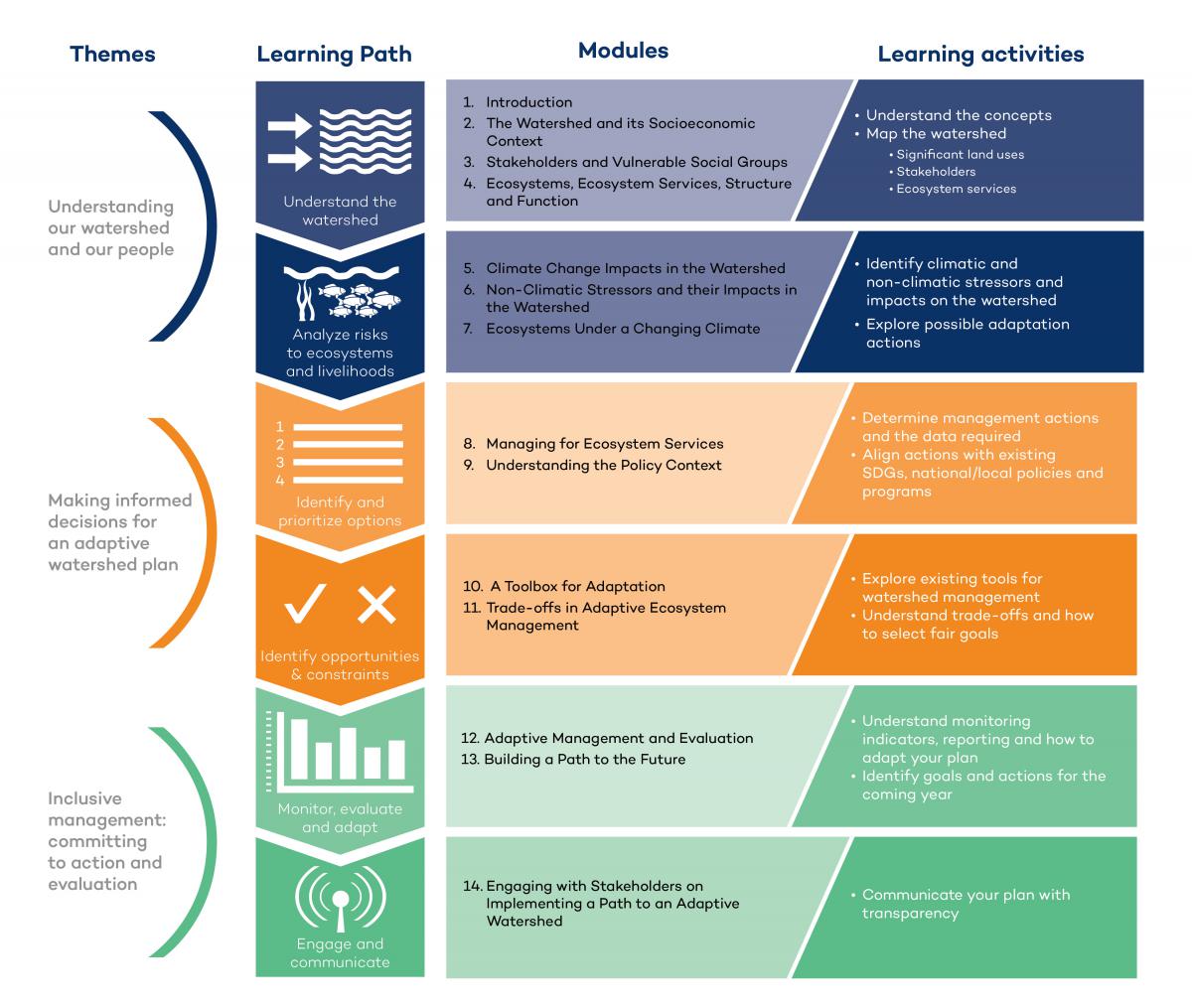
List of Modules Available to Download
- Module 1: Introduction
- Module 2: The Watershed and its Socioeconomic Context:A sense of time and place
- Module 3: Stakeholders and Vulnerable Social Groups
- Module 4: Ecosystems, Ecosystem Services, Structure and Function
- Module 5: Climate Change Impacts in the Watershed
- Module 6: Non-Climatic Stressors and their Impacts in the Watershed
- Module 7: Ecosystems Under a Changing Climate
- Module 8: Managing for Ecosystem Services
- Module 9: Understanding the Policy Context
- Module 10: A Toolbox for Adaptation
- Module 11: Trade-Offs in Adaptive Ecosystem Management
- Module 12: Adaptive Management and Evaluation
- Module 13: Individual and Collective Action for the Future of the local watershed
- Module 14: Engaging with Stakeholders on Implementing a Path to an Adaptive Watershed


You might also be interested in
Prairie Watershed Analytics
Prairie Watershed Analytics is focused on providing Canadians in the Prairies with the information they need to understand their local watershed. Watershed models can support local decision-makers and businesses with evaluating ecosystem services and connecting with environmental incentive programs. Prairie Watershed Analytics is making this practice simple and accessible using open data and toolsto automate and scale watershed modeling tailored to the Prairies.
Task Force for a Resilient Recovery
With ideas from Canada and around the world, our Task Force aims for a resilient recovery—one that delivers good jobs, is positive for the environment, and addresses inequality.
Unpacking the Implications of the International Court of Justice Advisory Opinion on Climate Change
The ICJ made history with its long-awaited opinion on climate change in 2025. We’re laying out what states need to know about their legal obligations.
Understanding Climate Risks Through an Intersectional Approach (iCRA)
This project investigates how intersecting systems of inequity based on gender inequality, ageism, ableism, and other forms of discrimination shape vulnerability to climate change. It will involve collaborative case study research, led by Prakriti Resources Centre in Nepal and Urban Earth in South Africa, to test how intersectional climate risk assessments (CRAs) can help to advance inclusive and effective adaptation in practice and policies.