
Inside the G7: Environment and energy
This year’s Group of 7 (G7) Summit will take place in Kananaskis, Canada, with leaders of some of the world’s largest economies gathering to discuss global challenges. IISD is chairing a dedicated T7 task force on Environment, Energy, and Sustainable Development ahead of the negotiations. Stay tuned for coverage and expert insights on these critical issues in the lead-up to the G7 Summit.
The 2025 Summit will mark the 50th anniversary of the G7. It is also the deadline for members to deliver on commitments to phase out inefficient fossil fuel subsidies and double climate finance for adaptation from 2019 levels.
With the clock ticking, G7 members continue to be some of the highest emitters in the world and are at risk of not meeting their climate obligations this decade.
Think 7 (T7) is the official G7 engagement group for think tanks and research centres, providing evidence-based recommendations to Canada’s G7 Presidency.
G7 Statements Omit References to Climate Change Amidst Increasing Wildfires
June 17, 2025
After two days of talks between G7 leaders in Kananaskis, only the Chair's summary makes a passing reference to climate, while one of the core statements coming out of the Kananaskis meeting focuses on the increasingly destructive threat of wildfires.
"The G7 sidestepped climate change in the leaders’ statements," said Patricia Fuller, IISD President and CEO, "despite acknowledging increased wildfires. Previous G7 commitments to act on climate change remain on the books and must be delivered. We will look to meetings of the G7 energy and environment minister under the Canadian Presidency to continue this work."
G7 Leaders’ Summit Recap: Climate, Energy, and Environment in Focus
June 16, 2025
As the G7 Leaders’ Summit unfolds in Kananaskis, Canada, this year’s format signals a shift in approach. Instead of a full communique—which requires consensus from all G7 members—Canada will issue a series of short chair’s statements. The final level of agreement behind each statement remains to be seen, and may vary. These could range from negotiated and endorsed documents to statements issued with minimal notice to other leaders.
Two draft statements are currently circulating: one on critical minerals and another related to the Iran-Israel conflict. Neither has yet been approved by U.S. President Donald Trump.
Energy Security: UN Secretary-General António Guterres is joining G7 and invited leaders to underscore the urgency of energy diversification, technology investment, and affordability in a rapidly changing world. He will also meet with Canadian Prime Minister Mark Carney on the margins of the summit, highlighting Canada’s leadership role. This session reflects a growing recognition that energy security and climate ambition must go hand in hand.
Critical Minerals: G7 leaders have provisionally agreed on a new strategy to strengthen the security and sustainability of critical mineral supply chains. The draft statement, still awaiting U.S. approval, recognizes that non-market practices in the critical minerals sector pose risks to both economies and national security. It calls for coordinated action to:
- Anticipate and address mineral shortages
- Respond to deliberate market disruptions
- Diversify mining, processing, manufacturing, and recycling
- Ensure markets reflect the true costs of responsible sourcing
This agenda lays a foundation for greater G7 alignment on industrial decarbonization and green technology supply chains, with potential to shape global standards and investment strategies.
While formal outcomes remain uncertain, IISD is calling on discussions to reflect climate action, clean energy security, and economic resilience at the highest level. As the summit continues, the decisions made—or avoided—this week will help determine whether the G7 is prepared to lead in the global clean energy transition.
2025 G7 Finance Communiqué: A shift away from climate leadership?
May 23, 2025
For the first time since 2019, the G7 Finance Ministers’ Communiqué did not include a set of actions to combat climate change. Also missing from the communiqué text were references to net-zero and a just transition.
This is a significant departure from last year, where the green transition emerged as a key theme.
Canadian Finance Minister and Chair of the Ministerial Summit François-Philippe Champagne explained that the communiqué is taking a “back to basics approach,” which aims to bring about G7 unity at times of economic and geopolitical uncertainty amid ongoing tariffs imposed by the United States. Yet experts warn that failing to highlight the urgency of the climate crisis carries significant economic risks for G7 members and for the global economy, including threats to critical infrastructure, supply chains, and affordability.
Although climate change was not addressed explicitly, there were some limited references to resilience and sustainability. These include
- a reaffirmed commitment to the World Bank-led Resilient and Inclusive Supply-chain Enhancement (RISE) Partnership, with a call for multilateral development banks to collaborate on critical mineral and clean energy supply chains;
- support for crisis preparedness and response tools, including climate-resilient debt clauses and insurance instruments;
- a reiterated endorsement of ongoing efforts to improve debt transparency and the G20 Common Framework for debt treatments; and
- a call to support vulnerable countries facing near-term liquidity challenges, even where overall debt levels are still deemed sustainable.
Anahí Wiedenbrüg, Senior Policy Advisor at IISD, points out that the language around improving the Common Framework and enhancing debt transparency does not offer anything new and falls short on the level of ambition currently needed. While the G7 did acknowledge the need to support countries dealing with short-term financial stress, it stuck to dichotomous ways of thinking by treating debt problems as either short-term “liquidity” issues or long-term “solvency” issues, when in reality, the situation is often more complicated. Only calling for additional support for countries facing “liquidity” issues will not suffice to support countries currently facing debt vulnerabilities.
Without stronger action from the G7, especially when it comes to providing fair climate finance and real debt solutions, there is a real risk that developing countries will see these vague promises as just talk, not action.
There was one glimmer of hope: the G7 reaffirmed its commitment to strengthening global supply chains for clean energy and critical minerals, which are key to a just and sustainable transition.
To stay credible as a global leader and leading up to the Leaders’ Summit in Kananaskis, Alberta, this June, the G7 will need to do a lot more—especially when it comes to supporting the countries most affected by both climate change and economic inequality.
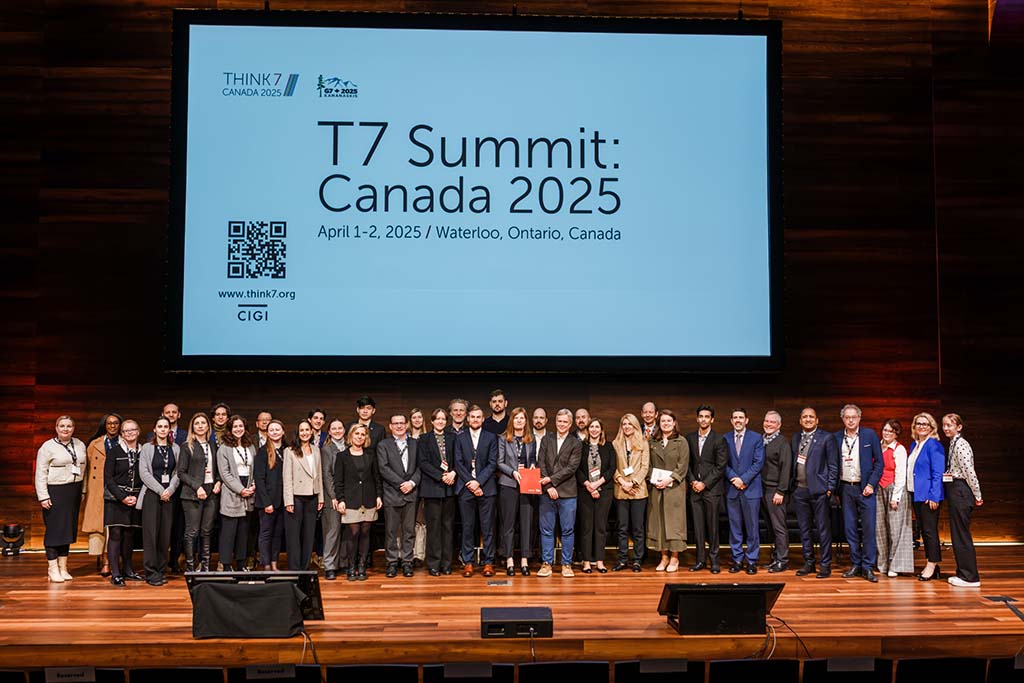
Think 7 2025: Environment, Energy, and Sustainable Development Recommendations
This year's Think 7 Communiqué included recommendations on environment, energy, and sustainable development addressed by Task Force 3. These were informed by five policy briefs developed following a rigorous selection process.
Here are the key contributions:
- Strengthen energy security and address climate change in an integrated approach.
- Scale up renewables and efficiency: Reaffirm the G7’s goal to triple renewable energy capacity and double energy efficiency by 2030.
- End fossil fuel subsidies: Commit to phasing out inefficient subsidies in 2025 and develop national action plans for any remaining fossil fuel subsidies within a year.
- Secure critical minerals: Diversify supply chains, support fair access, invest in recycling and circular economy models, and ensure sustainable extraction aligned with high environmental and social standards.
- Leverage artificial intelligence (AI) in energy systems: Use AI to optimize energy grids and improve efficiency by dynamically managing electricity supply and demand; create standardized protocols for energy data and AI use in infrastructure.
- Protect nature: Recognize that half of global GDP is dependent on biodiversity and commit to halting and reversing biodiversity loss by 2030 through full implementation of the Kunming-Montreal Global Biodiversity Framework.
- Improve access to financing for sustainable development and address the global debt crisis.
- Advance climate finance initiatives, including green credit lines and risk-sharing mechanisms such as the Just Energy Transition Partnerships, instructing multilateral development banks to support these efforts.
- Collaborate closely with the G20 and international financial institutions to support debt stabilization efforts, including through debt-for-resilience swap mechanisms, working with developing countries to build climate-resilient economies.
- Advance industrial decarbonization, sustainable trade, and investment
- Establish cooperative clean energy partnerships, particularly related to critical minerals production, to diversify sources, thus making clean technology supply chains more resilient and attractive to investors.
- Establish interoperable standards for carbon measurement to reduce trade frictions that could result from an uncoordinated framework for carbon border adjustment mechanisms.
- Eliminate tariffs on renewable energy technologies and standardize technical relations to streamline processing for these critical supply chains.
- Reiterate commitment to—and implementation of—the G7 Global Partnership for Infrastructure and Investment while integrating climate resilience into government decision making.
- Remove investor–state dispute settlement provisions to encourage low-carbon industry investment and ensure investment treaties do not interfere with national sovereignty.
See the full communiqué here.
Think 7 Policy Briefs: Environment, energy, and sustainable development
Explore the five policy briefs that informed the T7 Communiqué. Each brief offers in-depth analysis and actionable recommendations on environment, energy, and sustainable development.
“For the G7—and Canada as host—advancing energy security in alignment with climate targets is essential to strengthen economies, support residents, and maintain credibility on the global stage. Failure to act now would not only undermine economic prosperity but also weaken trust in our leadership at a time when it matters most.”
Patricia Fuller, President and CEO, IISD.

Need to Know
Our Insights

The G7 at a Crossroads: Advancing multilateralism, climate, environment, and energy action in an uncertain world
Canada’s G7 Presidency offers a critical chance to reaffirm the group’s leadership on climate action, resilience, biodiversity, and clean energy. Our experts break down what needs to happen to seize this moment.
Five Key Priorities to End Fossil Fuel Subsidies in Canada
As the G7 president in 2025, Canada has a pivotal opportunity to lead by fully phasing out fossil fuel supports and investing in a cleaner, more equitable future. Here are five recommendations for effective subsidy reform.

The G7 Should Lead the Transition Away from Fossil Fuels. Here’s how
At the upcoming G7 Leaders' Summit, there is a critical opportunity to consolidate and strengthen their progress on the energy transition, including on fossil fuel phase-out.

Compensation and Damages in Investor-State Dispute Settlement
This report provides policy reform options to address the growing issue of damages awards in investor-state dispute settlement (ISDS).

How Fossil Fuels Drive Inflation and Make Life Less Affordable for Canadians
New report takes closer look at how Canada’s dependence on fossil fuels impacts energy costs and prices of essentials such as transportation, home heating, and housing.
Effectively Delivering on Climate and Nature: NDCs, NAPs and NBSAPs Synergies
This checklist for national policy-makers illustrates potential opportunities and interactions during the development or update of the nationally determined contribution (NDC), National Adaptation Plan (NAP), and national biodiversity strategies and action plan (NBSAP).

The National Adaptation Plan (NAP) Process: Frequently Asked Questions
The NAP process is a strategic process that enables countries to identify and address their medium- and long-term priorities for adapting to climate change.
IISD G7 Experts

Patricia Fuller
President and CEO

Anna Ackermann
Policy Analyst

Aaron Cosbey
Senior Associate

Alec Crawford
Director, Nature for Resilience

Darcie Doan
Senior Specialist, Trade and Climate

Ivetta Gerasimchuk
Director, Energy Program, International Strategy

Anne Hammill
Associate Vice-President, Resilience

Cristina Larrea
Director, Agriculture, Food and Sustainability Initiatives

Isabelle Ramdoo
Director, IGF

Dimple Roy
Director, Water and Director, Manitoba Relations

Benjamin Simmons
Senior Director, Economic Law and Policy

Alice Tipping
Director, Trade and Sustainable Development