Webinar | Will Agricultural Growth Poles and Corridors Brighten Africa’s Future?
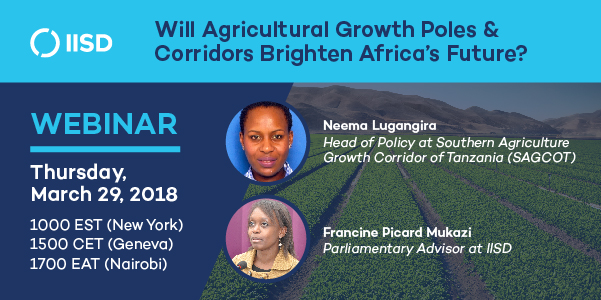
Join us for a webinar on Thursday, March 29, 2018 to discuss key challenges and opportunities of agricultural growth poles and corridors
African governments are deploying a new development tool: growth poles aimed at kickstarting the shift from subsistence to commercial agriculture.
Over a dozen agricultural growth poles, or “agropoles,” were established in the past four years, bringing the total to 36 growth poles and 9 corridors since 2002. They cover at least 3.5 million hectares of land in 23 countries, IISD research has found.
Please join us for a webinar on Thursday, March 29, 2018 to discuss key challenges and opportunities of agricultural growth poles and corridors. Specifically: are they a sustainable response to promote agro-industrial development and to contribute to food and nutritional security and the fight against poverty?
For a quick overview of the topic, read this blog. For a deeper dive, read our policy brief.
We invite you to register when you join the webinar online.
Upcoming events
From Evidence to Investment: The systemic challenges facing nature-based infrastructure
Evidence from 45 assessments in 29 countries shows that nature-based infrastructure delivers strong financial returns and social and environmental gains.
IGF 22nd Annual General Meeting
The 22nd IGF AGM will be held under the theme of Trust in an Interdependent World: Advancing inclusion and resilience in mineral value chains.
Session 2 | Financing a Transition Away From Fossil Fuels: Building an implementation network for Santa Marta workstream 2
Tailored to the Americas, Africa, and European regions, this webinar will drawing on existing initiatives and useful precedents for the transition away from fossil fuels with the goal of building a network to support country-led implementation.
Session 1 | Financing a Transition Away From Fossil Fuels: Building an implementation network for Santa Marta workstream 2
Tailored to Asia-Pacific, Africa, and European regions, this webinar will drawing on existing initiatives and useful precedents for the transition away from fossil fuels with the goal of building a network to support country-led implementation.