
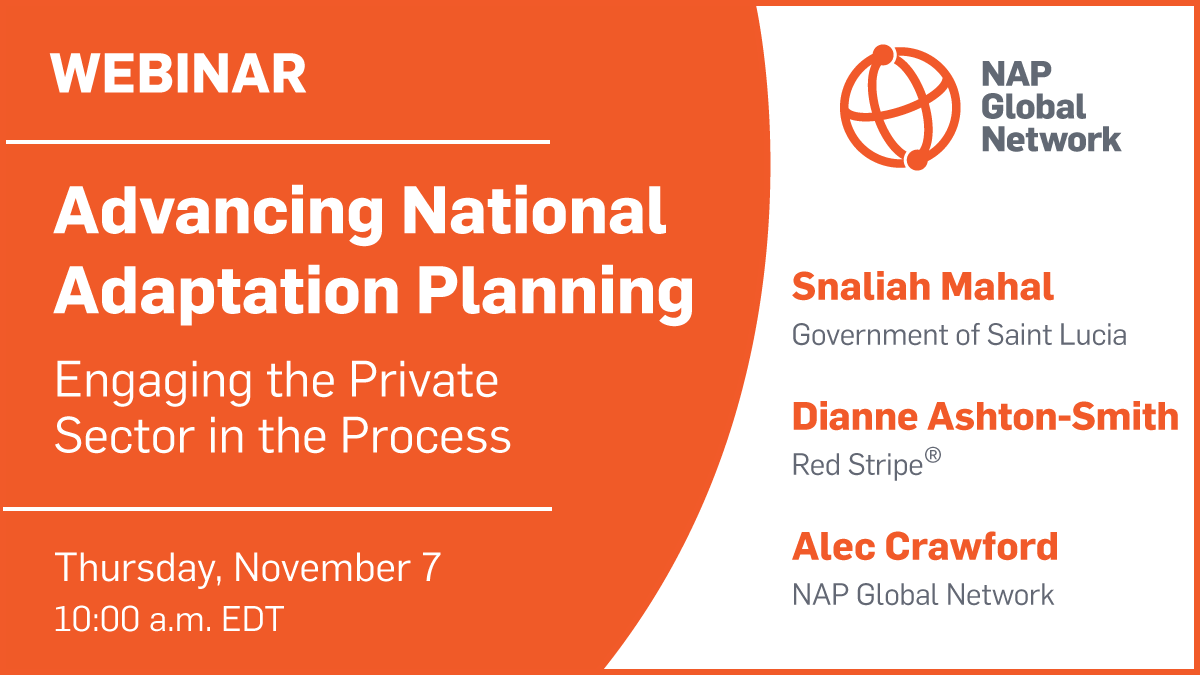
Webinar | Advancing National Adaptation Planning: Engaging the private sector in the process
Adapting to the impacts of climate change, whether at the national, subnational or community level, is not the responsibility of governments alone.
 It requires the coordinated input of multiple stakeholders, including local authorities, development partners and civil society. Businesses and investors will also need to be involved. The strategic and well-informed inclusion of the private sector in climate change adaptation activities is a key part of developing countries’ efforts to adapt to the impacts of climate change. The involvement of the private sector is not only desired, but necessary.
This webinar will:
- Outline the enabling factors that facilitate private sector engagement in NAP processes, namely information sharing, financing, capacity building, institutional arrangements, and policies and regulations.
- Offer practical guidance on how countries can design their NAPs to ensure that the private sector is engaged across the three phases of the NAP process: planning, implementation, and monitoring and evaluation (M&E).
- Provide examples of instances where the private sector has successfully engaged with the NAP process, as well as with climate change adaptation more broadly.
Speakers:
- Snaliah Mahal, Government of Saint Lucia
- Dianne Ashton-Smith, Red Stripe
- Alec Crawford, NAP Global Network
Watch the webinar's recording.
To learn more, read our guidance note on Engaging the Private Sector in National Adaptation Planning Processes
Upcoming events
From Evidence to Investment: The systemic challenges facing nature-based infrastructure
Evidence from 45 assessments in 29 countries shows that nature-based infrastructure delivers strong financial returns and social and environmental gains.
IGF 22nd Annual General Meeting
The 22nd IGF AGM will be held under the theme of Trust in an Interdependent World: Advancing inclusion and resilience in mineral value chains.
IISD at Building Bridges 2026
The International Institute for Sustainable Development will convene two sessions on making projects investable, from nature-based infrastructure in African cities to urban heat resilience solutions.
Session 2 | Financing a Transition Away From Fossil Fuels: Building an implementation network for Santa Marta workstream 2
Tailored to the Americas, Africa, and European regions, this webinar will drawing on existing initiatives and useful precedents for the transition away from fossil fuels with the goal of building a network to support country-led implementation.