Increasing number of Winnipeggers face limitations due to inadequate physical or mental support
Our Peg project reveals that the percentage of Winnipeggers reporting activity limitations due to inadequate physical or mental support is consistently higher than the national average.
Peg Report 30, May 16, 2017 – A new indicator featured on mypeg.ca measures the percentage of Winnipeggers who are sometimes or often limited in their ability to participate in an activity or carry out a daily activity due to inadequate physical or mental support.
The Activity Limitation indicator is also featured in an upcoming Peg report on the natural and built environments, to be released in connection with World Environment Day at the beginning of June.
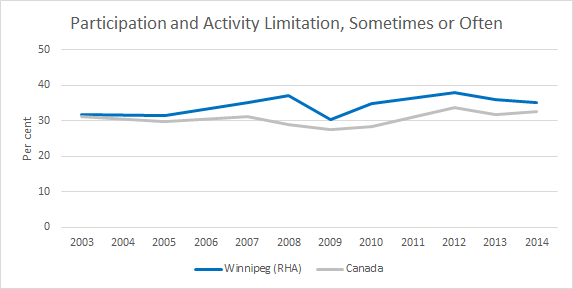
Peg data shows that the percentage of Winnipeggers reporting activity limitations is consistently higher than the national average.
What else can Peg tell us about activity limitation in Winnipeg?
Peg tells us…
- Between 2003 and 2014, the percentage of Winnipeggers who reported facing participation or activity limitation increased from 31.7 per cent to 35.2 per cent.
- An average of 34 per cent of Winnipeggers reported having activity limitations during this same period—3 per cent higher than the Canadian average of 31 per cent.
Definitions:
- This is a broad indicator that speaks to individuals’ accessibility based on mental or physical impairment or disability. The data source reports on individuals’ limitations in carrying out daily tasks or participating in events, but does not ask to specify the nature of the limitation.
Why does this matter?
- All Winnipeggers have the right to access services, participate in community and social events, and carry out daily activities. Common accessibility barriers are architectural or physical in nature, although they may also be technological, organizational, attitudinal or communication-related. Accessibility is important so that all Winnipeggers can reach their potential.
- The Accessibility for Manitobans Act (AMA) became law in December, 2013. This legislation provides a proactive process to remove barriers affecting persons with disabilities and many other citizens. Under this landmark legislation, the Manitoba government will develop mandatory accessibility standards. Each standard will address barriers for Manitobans in key areas of daily living. Standards will apply to Manitoba’s private and public sector organizations.[1]
- More details and source data for the above facts available at: http://www.mypeg.ca/explorer/WellBeing/BuiltEnvironment/Activitylimitation/
Source of the data:
- Peg’s data for the Activity Limitation indicator is provided by the Statistics Canada Canadian Community Health Survey (CCHS) CANSIM table 105-0502.
Media inquiries:
For interviews on understanding the trend (or the story behind the numbers), organizations making a difference in the community, Peg or the data, please contact:
Sumeep Bath, Media and Communications Officer
International Institute for Sustainable Development
(204) 958-7700 ex 740 | [email protected]
Social media:
Twitter: @Pegindicators
Facebook: MyPeg
Youtube: MyPegCIS
About us:
Peg (mypeg.ca) is a community indicator system that measures the health of our community year over year—in ways that count. Peg is led by two partnering organizations—the International Institute of Sustainable Development and United Way of Winnipeg.
Peg is the starting place for Winnipeg citizens, educators, policy-makers and many others to learn more about our city so we can lead change to create a better city for our children and their children. At Peg we can all learn how our lives, our neighbourhood and our city are changing—for the good and the bad. Learn more at www.mypeg.ca.
About IISD
The International Institute for Sustainable Development (IISD) is a globally recognized think tank with 3 decades of experience working to solve the world’s most pressing sustainable development challenges. We combine deep expertise in a wide range of issues with a collaborative approach to research, policy advice, and hands-on support to ensure these solutions are brought to life. Headquartered in Winnipeg, Manitoba, we are a diverse team of over 300 professionals working from offices in Canada, Switzerland, and other locations around the world.
You might also be interested in
Stalemate on the Global Goal on Adaptation in Bonn: What it means
Countries couldn’t reach an agreement on the Global Goal on Adaptation, but it doesn't change the need for them to track and assess their efforts.
A Measure of Care
As countries consider how to move beyond GDP in better measuring prosperity, this report explores how to ensure the unpaid labour of women is counted.
State of Global Environmental Governance 2025
Analysis of the wins and setbacks in international environmental negotiations in 2025 amid unprecedented challenges to multilateralism.
IISD’s Best of 2025: Publications
As 2025 draws to a close, we’re revisiting our most downloaded publications of the year.