IISD Refreshes Its Visual Identity
A new IISD visual identity, released over the past few months, is a recognition of the conviction that how we communicate our work is an integral part of our mission.
In the 25 years since IISD was established our mission to promote human development and environmental sustainability has become more urgent.
History-making strides have been made to lift billions out of poverty, yet the burden that we place on our natural environment is less sustainable than ever.
It was with that broad canvas as a back-drop that IISD renewed its strategic plan last year. The result places a tighter focus on six core priorities that meet the critical need for applied sustainability solutions.
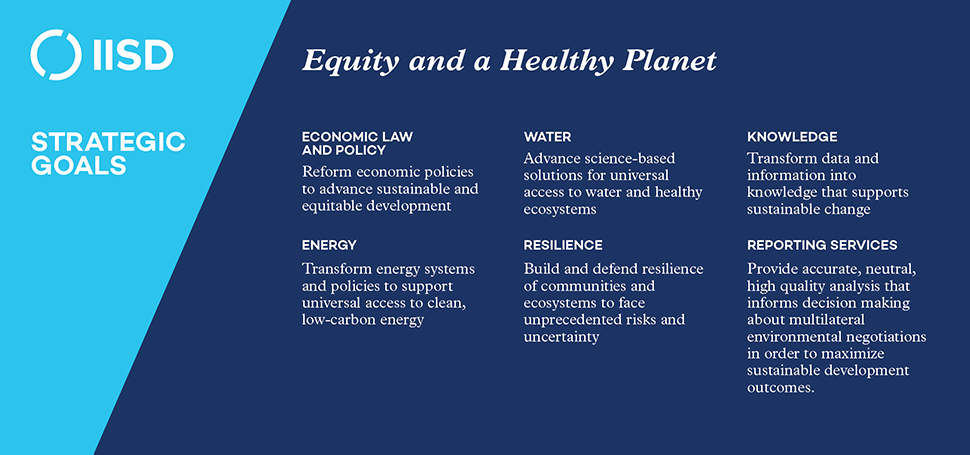
Underpinning our strategy is a belief that communicating both the vital importance of developing sustainably, as well as the work that IISD is doing in support of that objective, is essential to its success. IISD was a global leader in the use of innovative communication when it was founded, including as an early adopter of Web-based communications. But the communication landscape is moving at speed. So must we.
A new IISD visual identity, released over the past few months, is a recognition of the conviction that how we communicate our work is an integral part of our mission. And in the fall we will be launching a new website, which will mark a progression in our use of digital tools to increase our impact.
Designed by Studio Jaywall and Loop: Design for Social Good, the updated visual identity is a departure from our previous look, although it remains rooted in the mission and values that have guided IISD for 25 years. Our new logo is a minimal representation of the globe, split by an opening at 23.5 degrees (the angle of the Earth’s axis tilt). The globe represents IISD’s belief that humanity is confined to the limits of our Earth, while simultaneously representing the global reach of our applied research.
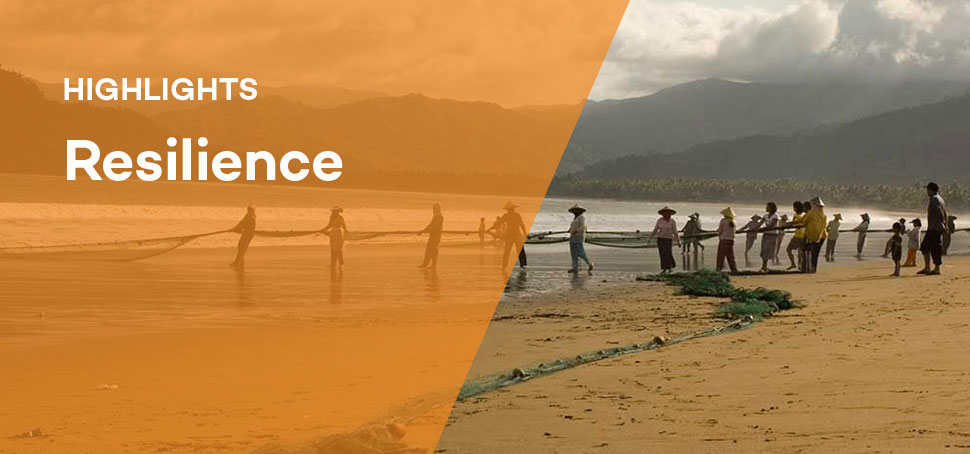
Our new identity is more than just the logo. It’s an entire toolkit of colours, fonts, and graphic elements that work together across all our materials. In particular, it is marked by the occasional use of a ‘shift’ mark, set at the same 23.5-degree angle as the logo. This speaks to the shifts in action that are required for sustainable development—in how we produce, consume, and share our planet’s resources. Below is an example from our recent annual report.
The visual identity as a whole speaks to IISD’s proud history of innovation and experimentation; of testing and championing bold ideas. That has meant tackling the pernicious problem of perverse subsidies—deemed intractable when we first began, but today gaining a strong foothold. It is evident in our focus on greening the financial sector, bridging water science and policy, and using forecasting and measurement tools in support of sustainable development goals.
In short, our new look cuts deeper than a change in fashion. It’s an effort to reflect who we are, how we view the world and the approach we take to our work.
Tell us what you think.
Damon Vis-Dunbar,Director of Communications[email protected]
About IISD
The International Institute for Sustainable Development (IISD) is a globally recognized think tank with 3 decades of experience working to solve the world’s most pressing sustainable development challenges. We combine deep expertise in a wide range of issues with a collaborative approach to research, policy advice, and hands-on support to ensure these solutions are brought to life. Headquartered in Winnipeg, Manitoba, we are a diverse team of over 300 professionals working from offices in Canada, Switzerland, and other locations around the world.
You might also be interested in
Midpoint of the UN Tax Convention Negotiations: Where do talks stand?
The negotiations for a new UN Framework Convention on International Tax Cooperation have hit their halfway point. Here's a look at where things stand, what was on the table this round, and what's coming next.
Canadian Exporters Face New Reporting Costs as Carbon Border Taxes Multiply
The European Union’s carbon border tax will add new compliance costs for Canadian businesses that trade certain products, especially steel and aluminum, to the bloc. The increased costs—linked to differing demands for measuring, reporting, and verifying a product’s greenhouse gas emissions across the growing number of countries adopting border carbon adjustment (BCA) mechanisms—“make it tough for any exporter to those markets,” Aaron Cosbey, senior associate at the International Institute for Sustainable Development (IISD), told The Energy Mix.
Experimental Lakes gets $2M for major facilities upgrade
A one-of-a-kind research station is studying small lakes to inform freshwater science all over the world is getting a new facility with more space for scientists and students. Located between Dryden and Kenora, the International Institute for Sustainable Development’s Experimental Lakes Area allows scientists and students to run experiments on 58 small lakes in the area.
Province investing $2M to ‘ensure northwestern Ontario remains a global leader in freshwater science and research’
The Government of Ontario is making a targeted investment to “strengthen northern Ontario's leadership in freshwater science, support research and innovation and create new educational and economic opportunities in the region.” On Aug. 13, the Northern Ontario Heritage Fund Corporation (NOHFC) — a regional granting subsidiary of the provincial government — announced that it will be investing $2 million to build a new Centre for Climate and Lake Learning at the International Institute for Sustainable Development Experimental Lakes Area (IISD-ELA), which is located about halfway between Kenora and Dryden.