CRiSTAL Parks: The Community-based Risk Screening Tool – Adaptation and Livelihoods with a focus on Protected Areas
February 25, 2015
CRiSTAL Parks, a decision-support tool that aims to help conservationists and Protected Area (PA) managers integrate climate risks into their conservation planning, was piloted in the Landscape Reserve Nor Yauyos Cochas (RPNYC) in Peru, from January 26–29, 2015.
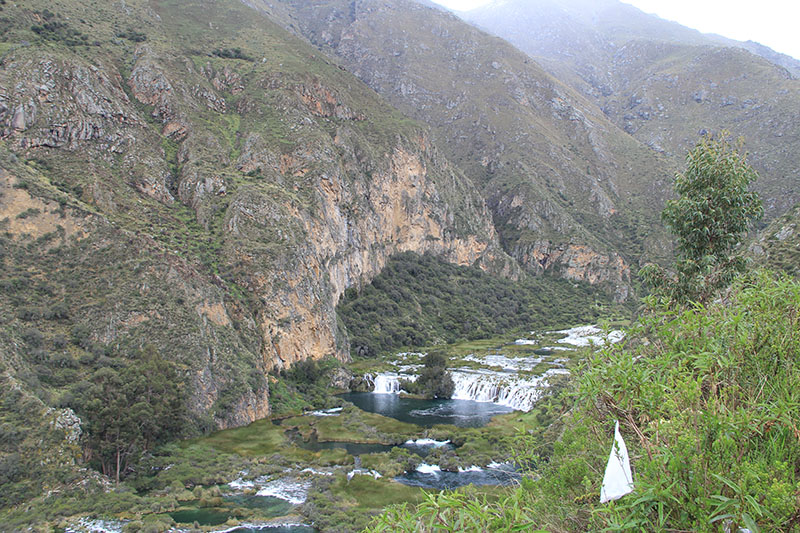
Photo: Alicia Natalia Zamudio (Huancava)
The workshop enabled its participants to find out about this new tool and test its applicability in a PA, and gave them the opportunity to provide feedback on how it could be improved. Pilot workshops are part of a field-based revision process to ensure that the tool responds to its future users’ needs.
The workshop was organized by the International Institute for Sustainable Development (IISD), the National Service of Natural Protected Areas in Peru (SERNANP) and the International Union for Conservation of Nature (IUCN). Participants included SERNANP (HQ, PA management team and park rangers), the management committee of the RPNYC, the Patronage of the RPNYC, the Environment Ministry (MINAM), local authorities (mayors of two municipalities), regional governments (two districts), the National Agrarian Research Institute (INIA), EbA Mountain Project staff and the National Commission of Natural Protected Areas in Mexico (CONANP).
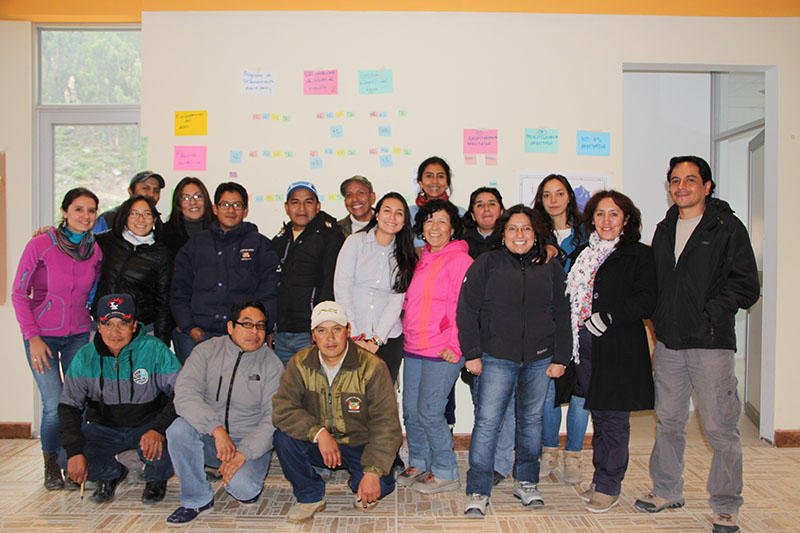
Photo: Alicia Natalia Zamudio (Laraos workshop participants)
Alicia Natalia Zamudio, project officer at IISD, explained that the “CRiSTAL Parks tool is designed to help conservationists and PA managers to better understand and integrate climate risks in conservation planning of protected areas. It provides a framework to design adaptation strategies that reduce vulnerability of critical ecosystems and livelihoods to climate variability and change.” She added that, “the tool is meant to be used in a participatory manner with key stakeholders for the management of a PA.”
Gonzalo Quiroz, director of the RPNYC, said that, “this tool was very useful to climate-screen the activities that have been recently consolidated as part of the management plan of the Reserve, ensuring that this updated plan includes climate adaptation strategies…and that this is a complementary tool.” Additionally, he highlighted that “this tool has the potential to empower and raise awareness among the diverse stakeholders regarding the planning processes of a PA.”
Karen Podvin, project officer at IUCN, mentioned that, “its step-by-step approach and its flexibility enables it to be adaptable to the needs of PAs.”
Participants to the workshop highlighted the tool’s “usefulness, accessibility and logical sequence.” They found that the tool’s structure and flexibility allowed its users to adjust conservation planning as needed. Finally, they stressed the importance of having a clearly defined purpose for using the tool and that the quality of the results depends of the level of analysis undertaken by its users.
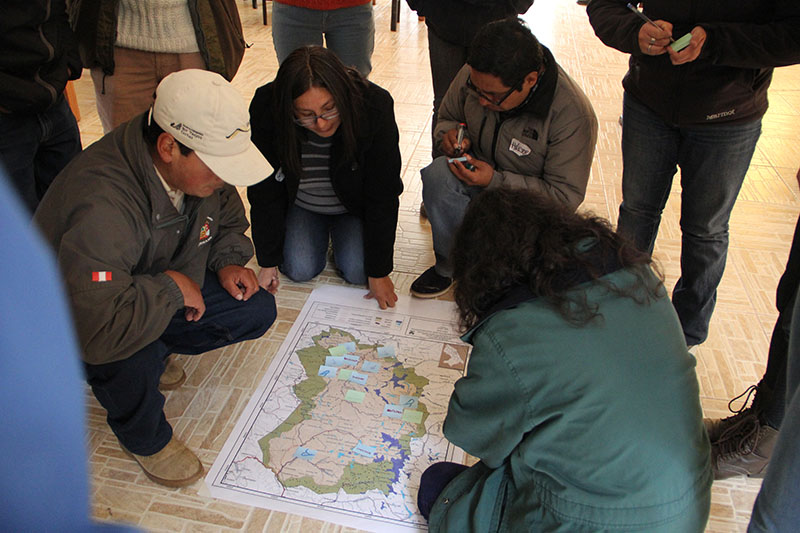
Photo: Alicia Natalia Zamudio (Laraos, resource mapping)
Additionally, on January 30, 2015, MINAM, SERNANP, IUCN and IISD presented the results of the workshop and introduced CRiSTAL Parks more broadly to about 30 participants from universities and non-governmental organizations with an interest in climate change adaptation and in the management of PAs.
During this meeting, Marco Arenas, in charge of the Participatory Management Unit under the PA Management Department from SERNANP, presented a few results from the tool’s pilot and emphasized that “in having seen how to use the tool, we see a potential for its use to be replicated in other PAs.”
Cecilia Cabello, director of the PA Management from SERNANP, mentioned that, “it is relevant to count with these types of practical tools to integrate climate change in the management toolkits of PAs, since PAs already respond to climate change through their sustainable use and conservation.”
Finally, Eduardo Durand, director general of Climate Change, Desertification and Hydrological Resources of MINAM, brought the meeting to an end by stressing that “the MINAM supports this type of initiative to share reflections between diverse actors about these dynamic tools that allow the integration of the climate change dimension into protected areas, as taking place within the broader landscape of efforts that the country is already making to deal with climate change.”
The tool is being refined and will be freely available towards the end of 2015 for those interested in using it to integrate climate risks into the management of PAs worldwide.
For more information please contact [email protected]
The quotations have been translated from Spanish into English
About IISD
The International Institute for Sustainable Development (IISD) is a globally recognized think tank with 3 decades of experience working to solve the world’s most pressing sustainable development challenges. We combine deep expertise in a wide range of issues with a collaborative approach to research, policy advice, and hands-on support to ensure these solutions are brought to life. Headquartered in Winnipeg, Manitoba, we are a diverse team of over 300 professionals working from offices in Canada, Switzerland, and other locations around the world.
You might also be interested in
Clean Energy Support is Saving Major Energy Importers Billions
New analysis finds public support for renewables and electrification is reducing dependence on imported fossil fuels, strengthening resilience to price shocks, and lowering energy costs.
At Least Seven BRICS+ Nations Shift EV Support to Buses and Two-Wheelers
New analysis finds that at least seven BRICS+ countries—Brazil, China, Ethiopia, India, Indonesia, Malaysia, and Thailand—are directing electric (EV) support toward two- and three-wheelers, as well as public and shared transport.
Midpoint of the UN Tax Convention Negotiations: Where do talks stand?
The negotiations for a new UN Framework Convention on International Tax Cooperation have hit their halfway point. Here's a look at where things stand, what was on the table this round, and what's coming next.
Canadian Exporters Face New Reporting Costs as Carbon Border Taxes Multiply
The European Union’s carbon border tax will add new compliance costs for Canadian businesses that trade certain products, especially steel and aluminum, to the bloc. The increased costs—linked to differing demands for measuring, reporting, and verifying a product’s greenhouse gas emissions across the growing number of countries adopting border carbon adjustment (BCA) mechanisms—“make it tough for any exporter to those markets,” Aaron Cosbey, senior associate at the International Institute for Sustainable Development (IISD), told The Energy Mix.