Almost 1 in 10 Winnipeggers has diabetes
November 14 is World Diabetes Day. How is Winnipeg doing?
FOR IMMEDIATE RELEASE
November 14 is World Diabetes Day. How is Winnipeg doing?
Peg tells us…
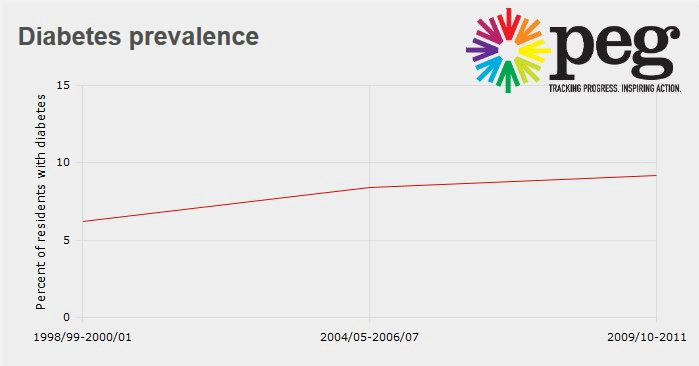
9.2% of Winnipeggers aged 19 or older were treated for diabetes between 2009/10 and 2011/12.
The facts are:
- The percentage of Winnipeggers aged 19 or older with diabetes (either Type I or Type II) has increased by 48% from ten years earlier; growing from 6.2% in 1998/99 – 2000/01 to 9.2% in 2009/10 – 2011/12.
- At the community level, diabetes rates are consistently highest in Point Douglas, Inkster, and Downtown, and lowest in Assiniboine South, River Heights and Fort Garry.
- The diabetes rate has increased 2.3% in Winnipeg’s highest income area vs. an increase of 4.3% in the lowest income area, and 3% city-wide.
- Diabetes prevalence rates are defined by hospitalization, physician visits, or prescriptions for diabetes medications.
Why does this matter?
- A significant number of Winnipeggers have diabetes, and in Manitoba diabetes is a major cause of heart disease, blindness, kidney failure and loss of limbs due to amputation. According to the Canadian Diabetes Association (CDA), Canadian adults with diabetes are twice as likely to die prematurely as those without diabetes. Diabetes prevention can reduce this burden of disease.
- The cost to the provincial health care budget is significant – a person with diabetes can face direct costs for medications and supplies ranging from $1,000 to $15,000 a year.
- The increase in overall rates is probably due to longer survival of people with diabetes because of improvements in medical and self-care, and continuing efforts around awareness and earlier identification of cases.
* More detail and source data for the above facts available at http://www.mypeg.ca/more-info, under the Diabetes prevalence tab
More facts on this subject available at:
Link to Peg data: http://tinyurl.com/pegdiabetes
Source of the data: Manitoba Centre for Health Policy
Available for interviews:
On Peg: Sumeep Bath Media and Communications Officer, IISD (204) 958-7740
| On diabetes and the Aboriginal community: Anita Ducharme, Executive Director National Aboriginal Diabetes Association (204) 927-1224
|
On the data: Dr. Randy Fransoo, Associate Director Research Manitoba Centre for Health Policy (204) 789-3543
| On diabetes in Manitoba: Andrea Kwasnicki, Regional DirectorManitoba/Nunavut Region Canadian Diabetes Association(204) 925-3800, ext 228
|
About us:
Regularly, the team at Peg releases data and facts that help us understand our city better. This is one of those regular reports. Others can be found at http://www.mypeg.ca/blog.
Peg measures the health of our community year over year – in ways that count. It is the starting place for Winnipeg citizens, educators, policy makers, and many others to learn more about our city so we can lead change to create a better city for our children and their children.
At Peg we can all learn how our lives, our neighbourhood and our city is changing – for the good and the bad. Learn more at www.mypeg.ca.
About IISD
The International Institute for Sustainable Development (IISD) is a globally recognized think tank with 3 decades of experience working to solve the world’s most pressing sustainable development challenges. We combine deep expertise in a wide range of issues with a collaborative approach to research, policy advice, and hands-on support to ensure these solutions are brought to life. Headquartered in Winnipeg, Manitoba, we are a diverse team of over 300 professionals working from offices in Canada, Switzerland, and other locations around the world.
You might also be interested in
Stalemate on the Global Goal on Adaptation in Bonn: What it means
Countries couldn’t reach an agreement on the Global Goal on Adaptation, but it doesn't change the need for them to track and assess their efforts.
A Measure of Care
As countries consider how to move beyond GDP in better measuring prosperity, this report explores how to ensure the unpaid labour of women is counted.
State of Global Environmental Governance 2025
Analysis of the wins and setbacks in international environmental negotiations in 2025 amid unprecedented challenges to multilateralism.
IISD’s Best of 2025: Publications
As 2025 draws to a close, we’re revisiting our most downloaded publications of the year.