66% of Winnipeg’s Homeless are Invisible to the Average Winnipegger
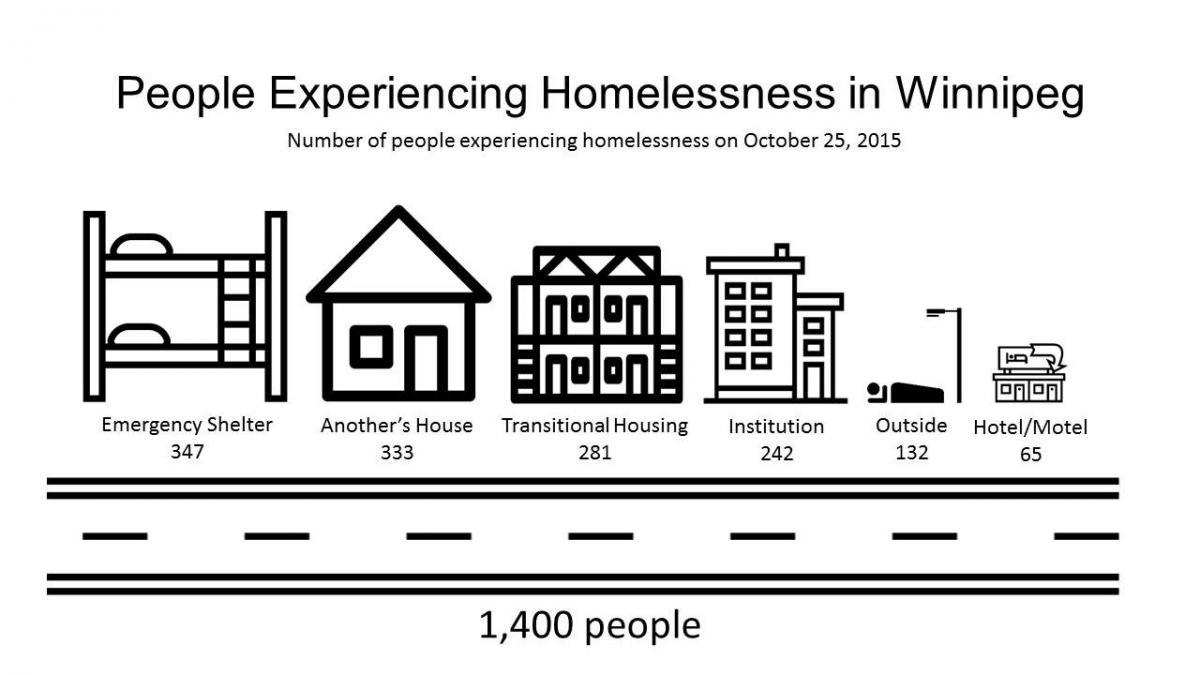
1,400 Winnipeggers were experiencing homelessness during the first Street Census Survey, completed in 2015. 66% of these people weren’t staying in shelter or sleeping outside, but were still without a home.
1,400 Winnipeggers were experiencing homelessness during the first Street Census Survey, completed in 2015. 66% of these people weren’t staying in shelter or sleeping outside, but were still without a home.
This is according to Peg, which is releasing this startling data just ahead of the National Conference on Ending Homelessness which is taking place October 25-27 in Winnipeg. For the first time, Winnipeg is greeting almost 1,000 individuals from across Canada, providing a forum for inspiration, information, tools and training to end homelessness.
What else can Peg tell us about homelessness in Winnipeg?
Peg tells us…
- Of those 1,400 experiencing homelessness on the night of the census:
- 347 were staying at an emergency shelter
- 333 were staying at another’s house
- 281 were in transitional housing
- 242 were in an institution
- 65 were staying in a hotel/motel, and
- 132 were sleeping outside.
Definitions:
- The Canadian definition of homelessness was used when developing methodology for the Winnipeg Street census. This definition includes a spectrum of living situations including unsheltered, emergency sheltered, provisionally accommodated and at risk of homelessness.
- Due to resource limitations and the use of point-in-time methodology, where all data is collected during a specific point in time, the complete range of homelessness was not included in the census. People not surveyed include people who were emergency sheltered due to fleeing natural disasters, people at imminent risk of homelessness and individuals and families who are precariously housed (SPCW, 2015, p.25).
Why does this matter?
- Homelessness affects a broad spectrum of people, including some of the city’s most vulnerable populations; youth, women and children and seniors. As there are many factors that contribute to being homeless, it often becomes increasingly difficult to regain self-sufficiency the longer a person is homeless (Government of Canada, 2016).
- Housing, more specifically affordable housing, is a basic need and is critical to well-being. It provides physical safety and peace of mind and allows individuals to prioritize other necessities that help improve quality of life such as continuing education, being employed, prioritizing health and the ability to build social networks within a community.
- More detail and source data for the above facts available at: http://www.mypeg.ca/explorer/WellBeing/BasicNeeds/homeless/
Source of the data:
- Peg’s data for the Quality of Life indicator is provided by the Social Planning Council of Winnipeg, via the Winnipeg Street Census 2015 final report. Retrieved from: http://streetcensuswpg.ca/wp-content/uploads/2016/01/WSC_FinalReport_
Media inquiries:
For interviews on understanding the trend (or the story behind the numbers), organizations making a difference in the community, the National Conference on Ending Homelessness, Peg, or the data, please contact:
Sumeep Bath, Media and Communications Officer, International Institute for Sustainable Development
(204) 958-7700 ex 740 | [email protected]
Social media:
Twitter: @Pegindicators
Facebook: MyPeg
Youtube: MyPegCIS
About us:
Peg (mypeg.ca) is a community indicator system that measures the health of our community year over year – in ways that count. Peg is led by two partnering organizations – the International Institute of Sustainable Development and United Way of Winnipeg.
Peg is the starting place for Winnipeg citizens, educators, policy makers, and many others to learn more about our city so we can lead change to create a better city for our children and their children. At Peg we can all learn how our lives, our neighbourhood and our city is changing – for the good and the bad. Learn more at www.mypeg.ca.
About IISD
The International Institute for Sustainable Development (IISD) is a globally recognized think tank with 3 decades of experience working to solve the world’s most pressing sustainable development challenges. We combine deep expertise in a wide range of issues with a collaborative approach to research, policy advice, and hands-on support to ensure these solutions are brought to life. Headquartered in Winnipeg, Manitoba, we are a diverse team of over 300 professionals working from offices in Canada, Switzerland, and other locations around the world.
You might also be interested in
From Voluntary to Binding
This report examines how sustainability standards and initiatives are integrated into public mining governance, from voluntary to mandatory use, with case studies from Brazil, Madagascar, and Sweden.
Why the Scope of Taxes Covered Will Determine the Success of the UN Framework Convention’s Services Protocol
This article analyzes the UNFCITC draft protocol on cross-border services and its ambitious proposal to cover digital service taxes and quasi-income levies.
A Turning Point for Digital Trade Policy
A report on the expiry of the World Trade Organization e-commerce moratorium at the Fourteenth Ministerial Conference, the unresolved questions of scope and definition, and what the emerging landscape of customs duties commitments means for developing economies.
IISD Submission to the Belém Mission to 1.5
This submission is made in response to the invitation from the United Nations Climate Change Conference (COP) 29, COP 30, and COP 31 Presidencies on the Belém Mission to 1.5.