
Five Reasons Climate Change Adaptation Is a Challenge for Rural Canada, and What We Can Do About It
Canada, like every country in the world, needs to build resilience to the impacts of climate change. However, despite the benefits of planned adaptation, barriers to adaptation progress remain, especially for rural communities.
Climate change adaptation in Canada, as in many countries, is constrained by its complexity.
Effective climate change adaptation requires a whole-of-society approach. It involves coordinated action across jurisdictions, sectors, disciplines, and knowledge systems with differing perspectives and priorities. With so many actors involved, it is often unclear who should lead adaptation efforts and who should be engaged in planning, implementation, and evaluation.
These characteristics create obstacles for all actors, but more so for small, remote, and rural communities such as those that dot the Canadian Prairies. The more constrained financial and human resources of these communities, as well as their more limited access to services, pose particular challenges for adapting to increasing climate risk.
At the same time, rural communities are often on the frontlines of increasingly damaging floods and wildfires, and can be dependent on climate-sensitive economies such as forestry, fishing, and farming.
Below, we explore five barriers to adaptation progress in rural areas, particularly through the use of nature-based solutions like natural infrastructure, a “multi-solving” solution that will help build resilience while addressing other overlapping crises.
1. One-Size-Fits-All Funding Mechanisms
Small, rural, and remote communities face distinct barriers to accessing adaptation funding due to limited tax bases, smaller populations, and program requirements such as matching funds or demonstrated returns on investment. Programs like the Federation of Canadian Municipalities’ Local Leadership for Climate Adaptation initiative have increased adaptation planning, but it remains unclear whether the hundreds of rural municipalities in Manitoba and Saskatchewan are benefiting proportionately.
Moreover, despite larger cost-sharing for smaller communities, the high cost of major adaptation measures—such as floodplain restoration, managed retreat, diversions, and wildfire management—continues to limit implementation in rural areas.
2. Insufficient Training and Capacity
Canada’s workforce is well equipped to design and deliver traditional grey infrastructure, but lacks widespread training in climate-resilient and nature-based solutions. This shift is especially needed in rural, small, and remote communities, where limited staff capacity, aging assets, and heightened climate risks make it disproportionately difficult to adopt proactive approaches. With few local technical experts to rely on, these communities struggle to navigate the complex funding applications, project management demands, and administrative requirements that come with nature-based solutions and climate adaptation. While education and professional development are beginning to address these needs, they are far from mainstream. As a result, new projects often default to conventional designs rather than integrating updated climate projections and natural infrastructure options into planning, design, and implementation—missing opportunities to deliver essential services in ways that also build long-term resilience.
3. Limited Follow-Through
More municipalities have developed—or are in the process of developing—adaptation plans. Due to limited capacity, many smaller communities depend on external specialists and consultants to lead these planning processes. Once the consultancy is over, municipalities can be left uncertain about next steps, roles and responsibilities, and the resources needed to move from planning to implementation. If a local champion doesn’t take ownership or external support doesn’t continue through implementation—often because there is no funding to sustain it—it becomes challenging for plans to be embedded in day-to-day decisions, regularly updated, or translated into concrete actions.
4. Data and Information Gaps
While tools like the Climate Atlas of Canada and ClimateData.ca have improved access to climate projections, gaps remain in the availability and understanding of the non-climate data needed for robust risk and vulnerability assessments. The disaggregated health and social data needed to assess vulnerability to climate risks can be difficult to access or unavailable. Moreover, proxy indicators such as income, education, race, and gender do not capture the complex, place-based, and dynamic nature of the factors that influence the vulnerability of different groups. While this data is critical for targeting vulnerable populations, it is often poorly understood and improperly used.
Communities also face challenges in accessing climate-risk-informed data sets. For example, delays in releasing climate-informed flood-risk maps limit developers’ and planners’ ability to account for changing risks, resulting in continued development in areas increasingly exposed to flooding, wildfire, extreme heat, and other climate hazards.
5. Fixed Mindsets
Scaling nature-based solutions for climate change adaptation requires a shift from grey infrastructure toward hybrid and natural approaches. Municipal engineers and planners must recognize natural areas as infrastructure assets, not just recreational or aesthetic spaces. While initiatives such as the Natural Asset Initiative are advancing this shift, progress remains slow.

Enabling Factors for Adaptation
The International Institute for Sustainable Development’s (IISD’s) work with governments in Canada and around the world has informed our focus on the following seven key factors for enabling adaptation:
- leadership
- institutional arrangements
- financing
- engagement
- skills and capacity
- data, knowledge, and communications
- technology
These enabling factors are mutually supportive, which means that a gap in one area can undermine progress in another. Determining which combination of interventions are needed to enhance these factors varies by the local context, the risks being addressed, and the solutions being proposed.
Of these seven enabling factors, leadership, tailored financing, and coordinated policy across all levels of government are of critical importance for rural Canada.
Senior-level champions for climate resilience play a key role in driving adaptation planning and mainstreaming its implementation. Significant, sustained progress has been achieved in small communities where a local leader has recognized the growing risk of climate change and prioritized actions, including nature-based solutions, that build resilience to key hazards.
The iterative adaptation process also requires long-term, predictable funding, otherwise it risks losing momentum before resilience improvements are actually realized. When funding is available, such as through the federally funded Natural Infrastructure Fund announced in 2021, we have observed an uptick in the number of communities that have prioritized investments in the retention and enhancement of their natural infrastructure assets or the development of new natural infrastructure solutions.
And finally, effective adaptation depends on clear, coordinated policy across all levels of government, and we observe that aligned provincial and federal initiatives have increased municipal adaptation planning and the inclusion of natural infrastructure. Policies at all levels—local, regional, provincial, and federal—shape the implementation of natural infrastructure across the Prairies. IISD research shows that integrating these considerations across governance levels creates an enabling environment that boosts climate-resilient action.
Ways Forward
Finance
A critical and persistent challenge to greater climate adaptation action, particularly in rural, remote, and small communities, is access to financing. Despite clear evidence that investing in planned adaptation can protect lives and livelihoods while delivering strong economic returns, these arguments have not yet significantly shifted the narrative or driven sufficient public funding for adaptation action.
Yet for small, rural, and remote communities, public sector funding remains the primary driver of adaptation and natural infrastructure projects—not by choice but by necessity. These communities often face steep barriers to attracting private finance due to their smaller populations, limited economic activity, and higher perceived risk. Climate-resilient and nature-based approaches are difficult to monetize and offer lower returns. Without the technical capacity or financial tools needed to structure complex partnerships, many communities depend heavily on public funding to move forward, especially when upfront costs are high and benefits take years to materialize.
Efforts to expand the private sector’s role in financing adaptation actions must align with the sector’s expectations regarding the size, risk, and return characteristics of its investments. Private sector investors are more likely to invest in specific sectors, such as infrastructure, agriculture, and water management, where there is greater potential to generate revenue and provide a sufficient return on their investment.
Successful financing models in the United States and other regions are spurring greater investor confidence in natural infrastructure as a solution to a range of challenges, including climate change impacts. Outcome-based approaches that tie funding to performance show particular promise—especially for restoration projects that generate new ecosystem service revenues.
Where opportunities exist for expanding private financing in the adaptation space through these instruments, it is crucial to safeguard local land rights, maintain affordability and access for rural and underserved communities, and ensure that monetizing ecosystem services—such as through carbon credits—results in genuine environmental gains.
Infrastructure Investment
Secondly, within the public sector, climate resilience should be integrated into all new built, natural, and hybrid infrastructure investments. A key objective of all federal investments in new and upgraded built infrastructure, such as through the Build Canada Strong Fund and Build Canada Homes agency, must be ensuring their long-term climate resilience. As highlighted in a recent Canadian Climate Institute report, this type of proactive adaptation investment can not only ensure that Canada’s infrastructure is robust in the face of greater climate risks but also save millions of dollars per year in economic and social costs over their lifespan.
New infrastructure investments must also be designed to facilitate the uptake of climate-resilient natural infrastructure. IISD has identified 14 criteria that influence decisions to invest in natural infrastructure that should inform the design of federal funding programs.
Multi-Solving
Finally, greater emphasis in policy design and communication should be placed on multi-solving—reflecting the potential for many actions taken to increase resilience to climate change to simultaneously address other social, ecological, and economic crises facing Canada.
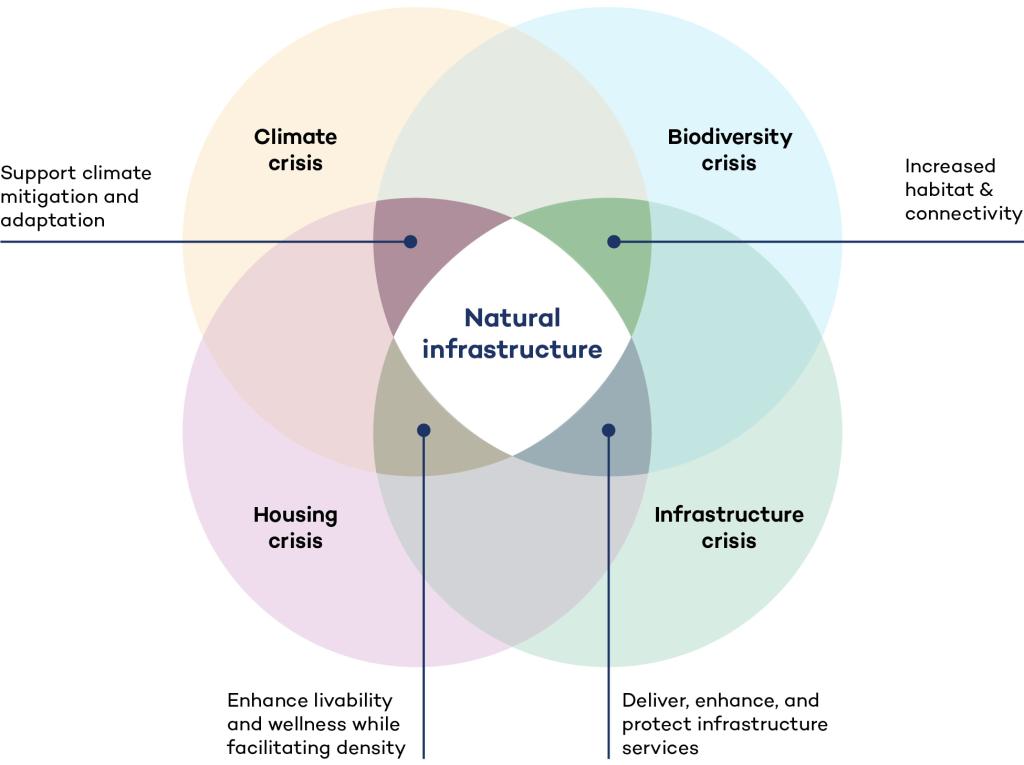
The climate, biodiversity, infrastructure, and housing crises are deeply interlinked, and the solutions to them must be equally interconnected. In communities, this can include planting trees within soil cells along streets and boulevards. When connected to the stormwater system, this solution can improve stormwater management, enhance air quality, boost biodiversity, and create more livable spaces, while simultaneously reducing climate risks, such as heavy rainfall and extreme heat events.
In rural regions, converting flood-prone annual cropland to flood-tolerant perennial grasses demonstrates multi-solving in action. Reconnecting rivers to their floodplains provides natural flood storage, reducing downstream flood risk to communities and infrastructure. At the same time, deep-rooted perennials enhance biodiversity, ease pressure on costly grey infrastructure, and reduce financial and operational stress for producers—advancing climate resilience, ecological health, and agricultural viability in a single intervention.
Prioritizing the multi-solving benefits of adaptation action not only increases the co-benefits for communities but also strengthens arguments for the greater value of adaptation action and its return on investment.
About the Authors

Ashley Rawluk
Policy Advisor
Ashley is a policy advisor with IISD’s Water and Resilience programs. She has experience with nature-based solutions and wetland and grassland projects across southern Alberta, with a focus on enhancing ecosystem goods and services.

Jo-Ellen Parry
Director, Cross-Resilience Initiatives
Jo-Ellen Parry undertakes research, analysis, engagement and management activities within IISD’s Resilience Program. Her work strives to build the capacity of communities and governments in Canada and developing countries to manage climate risks.
You might also be interested in
Tracking Progress on Sustainable Jobs in Canada
A practical guide to monitoring Canada's just transition, drawing on best practices to track progress toward sustainable jobs and equitable outcomes.
For Nature-Based Solutions to Be Effective, We Need to Work with Indigenous Peoples and Local Communities
Nature-based solutions have been praised as a promising approach to tackling the twin crises of climate change and biodiversity loss. But some Indigenous Peoples and local communities are questioning the legitimacy of the concept and what it symbolizes. It is time to listen to what they have to say.
Natural Infrastructure Essentials
On the Canadian Prairies, the need for water storage to cope with climate change is increasing. Natural infrastructure provides a solution.
From Patchwork to Production
Canadian waters hold some of the world's most promising offshore wind resources, but incomplete and fragmented regulations threaten to leave that potential stranded. Getting the rules right is now a strategic imperative.