Analysis

Freezing government policy: Stabilization clauses in investment contracts

To a significant extent the site of debate about the terms of globalization and its relationship to the regulatory state has shifted from the World Trade Organization to the world of investment treaties and arbitration. Investment treaties typically confer on a foreign investor a right to sue a host state that has allegedly failed to comply with a number of substantive obligations, typical among them the requirement to compensate for expropriation, fair and equitable treatment, and national treatment.

2010 midterm congressional elections in the United States: Implications for new U.S. International Investment Agreements

The Republican victories in U.S. congressional elections on 2 November 2010 are widely assumed to have increased the odds that the Obama administration will proceed with new bilateral investment treaties (BITs) and free trade agreements (FTAs) containing investment chapters. But this assumption bear closer examination. The post-election situation is complex.

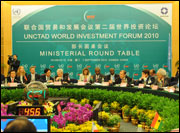
UNCTAD’s 2010 World Investment Forum: High-level experts discuss investment policies for sustainable development

The 2010 World Investment Forum (WIF), held on 6-9 September 2010, in Xiamen, China, turned UNCTAD into the global gravity center for open, universal, inclusive and high-level international investment discourse and policy formation. Eight events and conferences were attended by more than 1,800 participants from 120 countries and 16 international organisations, among them nine heads of State, four heads of international organisations, 79 ministerial-level officials, and 116 senior business executives.

Fairness and independence in investment arbitration: A critique of “Development and Outcomes of Investment Treaty Arbitration”

There has been recent interest in the use of quantitative research tools to evaluate the fairness and independence of investment arbitration. In this article, Professor Gus Van Harten critiques one of the most prominent studies to examine this question. While the study in question, “Development and Outcomes of Investment Treaty Arbitration” (2009), has been used in some policy circles to support the argument that investment arbitration functions fairly, Van Harten argues it has limitations that prevent such conclusions.

A global thirst: How water is driving the new wave of foreign investment in farmland

It is no longer a secret that there is a new wave of foreign investment in farmland, predominantly in Africa. An explosion of media reports and a series of studies by the World Bank, Food and Agricultural Organisation (FAO), International Fund for Agricultural Development (IFAD), United Nations Conference on Trade and Development (UNCTAD) and International Institute for Environment and Development (IIED), have confirmed the scale and consequences of this new influx of foreign investment. The World Bank report, by far the most comprehensive, found that reported deals amounted to 45 million hectares in 2009 alone.

The transparency requirement in the new UNCITRAL Arbitration Rules: A premonitory view

Ignacio Torterola  In October, State delegations are expected to discuss the issue of transparency in the UNCITRAL Rules of Arbitration.  Ignacio Torterola, ICSID Liaison at the Argentine Embassy in Washington, […]

Reclaiming the public interest in Europe’s international investment policy: Will the future EU BITs be any better than the 1200 existing BITs of EU member states?

The Lisbon Treaty has shifted the competence related to Foreign Direct Investments (FDI) from the European Union Member States to the Union and has added it to the Union’s exclusive common commercial policy. This transfer of competence not only requires the development of a common EU investment policy, but also legislative steps to clarify the status of the 1200 existing Bilateral Investment Treaties (BITs) of the EU Member States and their ongoing BIT negotiations. This offers a unique opportunity for an assessment of the existing BITs and for an open and broad discussion on the future European international investment policy.

Towards a comprehensive European international investment policy: An interview with Tomas Baert, European Commission, Directorate General for Trade, Services and Investment

With the EU’s Lisbon Treaty granting the European Union competence over Foreign Direct Investment, the European Commission released two documents in July that help chart the way forward: a draft […]

Investment Arbitration in Brazil: Yes or No?

By Elizabeth Whitsitt and Damon Vis-Dunbar30 November 2008 In 1991, Brazil began one of the world’s largest privatization programs, selling more than US$100 billion worth of assets. Seventeen years later […]