The Tribunal: A powerful exposition of investment arbitration’s distance from and indifference to lived realities
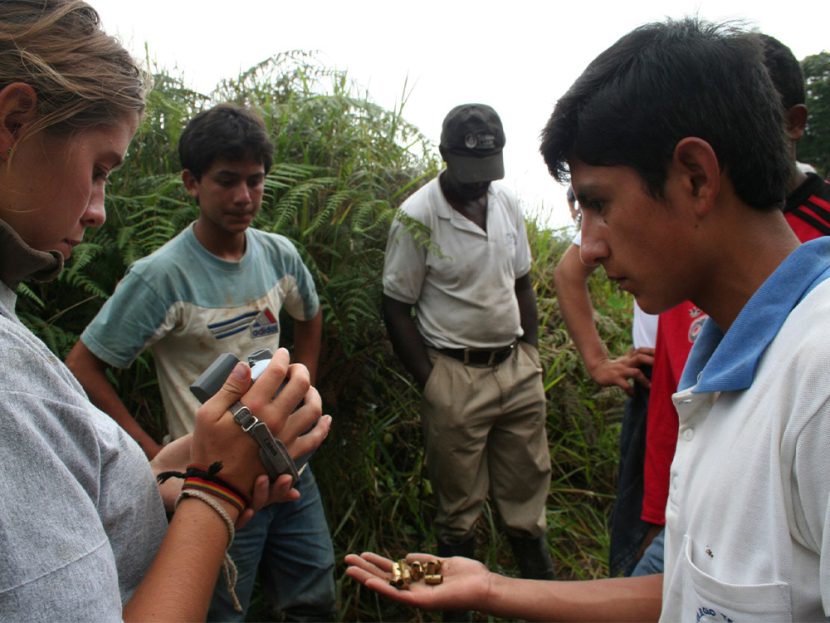
The Tribunal is a riveting documentary film about how communities in the Intag region of Ecuador resisted a copper mining exploration project that is impacting land, forests, watercourses, biodiversity, and livelihoods, in the face of oppression from both the mining company and public authorities. The film brings to light how the communities whose lives and livelihoods were at stake were excluded from the international arbitration process. This process determined whether the mining company was entitled to compensation after the Ecuadorian government cancelled its mining licence following the company’s failure to adequately consult with Intag communities. Instead of consulting the affected community, the company resorted to force and intimidation by filing strategic lawsuits against public participation and hiring paramilitaries who physically assaulted members of the community, as well as firing guns and spraying teargas at them. The Tribunal should be essential viewing for anyone working in the fields of international investment law and business and human rights, but most importantly for arbitrators and practitioners of investment law and arbitration.
In this short review, we address two themes that The Tribunal powerfully illuminates: the distance of investment arbitration from the lived realities of impacted communities and the erasure of human rights and environmental impacts.
Distance
The Tribunal brings to light the distance of investment arbitration proceedings from the lived realities of affected communities in several layers—the physical distance, the epistemological distance, and the cultural distance.
The arbitral tribunal that decided Copper Mesa’s claim against Ecuador was composed of three white European men (Dr Bernardo Cremades, Judge Bruno Simma and V. V. Veeder, QC) sitting in the Hague and Washington, DC, for the proceedings. When Cecilia, an environmental campaigner, speaks about this in The Tribunal, she emphasizes that the process is very distant from the community’s view, in the United States, in England, and in Europe, not in Ecuador, nor close to the affected community in the Intag region. The proceedings and the final award were in English, and the award was not officially translated into Spanish. The location of proceedings, the background of arbitrators, and failure to translate the award result in affected community members being excluded from the process and documentation dealing with the impacts they suffered.
The disputing parties being Copper Mesa and Ecuador, the grievances of the communities were only told from the perspectives of the disputing parties to the extent such grievances related to their claims or defences. In The Tribunal, community organizer José Cueva tells the story of how three European lawyers representing Ecuador came to visit them and asked several members of the community to travel to Washington, DC, to testify, as part of Ecuador’s defence. They agreed to testify about the human rights abuses they had suffered and travelled to Washington, DC, to support Ecuador’s defence, even though at the time they were being prosecuted by the authorities for their resistance to mining in the region. They waited several days sitting in the ICSID offices to be called in by the tribunal for their testimony. They were not called in and returned home without having had the chance to tell the tribunal how they were harmed by Copper Mesa. They were not given reasons as to why they were not heard.
In contrast, the tribunal’s actual award cites as a “reliable factual witness” Copper Mesa’s President and CEO, since 2004, Gerald Davis, who “was not previously involved in the Claimant’s concessions in Ecuador. He does not speak Spanish; and he had not previously worked in Ecuador” (para 4.5). But he had 30-plus years of experience working in the mining sector. The knowledge of the community members that could have been brought to bear in the resolution of the Copper Mesa dispute—to which the grievances of the community were central—was distanced from the procedure. Their experience was told only from the perspectives of the investor and the government. The decision-makers and the procedure itself were far from the realities of the communities, physically, epistemologically, and culturally. José Rívera, who is a farmer and an educator, puts it aptly when he says, “These events did not happen in Washington, they happened here, in Intag, in Ecuador. If the tribunal came here and could feel what is really happening, I think their decisions would be very different.”
To a large extent, investment arbitration owes its legitimacy to its claim of impartiality and depoliticization of investment disputes. The experiences of local communities shared in The Tribunal show that investment arbitration’s claim of impartiality and depoliticization perpetuates the distancing of legal procedures from the aggrieved communities and leads to the erasure of their rights, claims, and voices.
Erasure of human rights abuses
The distance caused by the lack of translation of the final award is compounded by the seeming erasure of human rights abuses by the tribunal.
In The Tribunal, Silvia Quilumbango, an environmental defender and college professor, flips through the final award, which was and remains redacted, even for the victims. It’s the first time she has seen the decision.
“So much of it is blacked out. What is it that they want to hide?”
The redacted versions appear to relate to the worst conduct by the investor. She flips to a section titled, “The incidents in the village of Chalguayaco Alto,” and then through pages of redacted text.
“In other words, where we suffered the worst violations of our rights.”
You can see her try to grapple with the potential that the tribunal misunderstood the gravity of what she and her community endured.
“Because it was a week of terror. Because it wasn’t just one day, it was a whole week. And the incidents continued … And the information is blacked out. Wow. How crazy to know that everything that happened, nobody can know. Nobody.”
An “Intag resident, anti-mining activist” named Silvia Betancourt is listed in the tribunal’s “Dramatis personae” but never appears in the text again. She is not alone. Mary Ellen Fieweger, Hector Flores, and Sixta León are all listed in the “Dramatis personae” without the award mentioning them any further. One can only presume their lives—the narrative of their lives—is under black lines.
Beyond the degrading notion of a “dramatis personae”—a term that carries the connotation of a novel or play, rather than real people’s lives—the erasure of their lives and the human rights abuses they endured is disconcerting. Admittedly, it is difficult to fully account for how much the human rights abuses actually affected the tribunal’s decision, as the final award is heavily redacted. It is possible that under pages and pages of blacked-out lines, the tribunal took the company to task for its conduct. This raises a significant question: if abuses are only privately acknowledged but publicly erased, does it matter?
The actual, physical erasure of the human rights abuses within the Copper Mesa award—and the sense of the community that the abuses were erased more substantially—has significant consequences both for the narrow case of the Intag residents and for the larger tension between human rights and investment law.
Most immediately, erasing the human rights abuses suggests they were not central to the case, yet they were. The Intag communities had a history of opposition to mining projects that predate Copper Mesa. The opposition is not pointless; it relates to the communities’ concerns over the impact on their water sources, their environment, their culture, and their livelihoods.
The company was aware, or should have been aware, had it done adequate due diligence, that it would not have an easy reception. As detailed in the judgment (para 4.26), an earlier investigation into the situation by the Japanese International Co-operation Agency had concluded that
It will be necessary to give the inhabitants sufficient explanation of the progress of the resettlement process, to ensure the safety of the resettlement locations and to guarantee them with the consent of the inhabitants. In the event that agreement cannot be reached to resettle the inhabitants, it will be necessary to change the development plan.
Still, as the tribunal’s decision finds, the company did not attempt to secure local buy-in. Instead, the decision makes clear (perhaps inadvertently) that the company took advantage of a division between “pro-mining” and “anti-mining” members of the community to ignore the opposition (paras 4.74, 4.76, 4.96). The decision does not address the extent to which the company created or enhanced this community discord. In places that are likely to be hostile to mining, it is not an uncommon practice for companies to seek out opportunities to create a division within the community. This can come in the way of financial or job-based incentives and promises to individual members of the community. Sometimes, those promises come to fruition, but often they do not.
The erasure of the violations serves to reduce or limit the scope of concern that the decision’s readers are expected to have for anyone other than the investor. We are not, as readers of the decision, meant to care about the violations or hold the investor responsible. The conflict in Intag stems from the company’s willingness to enter the region while intentionally ignoring this opposition and public concern. The subsequent violence is in addition to the failure to consult. The erasure of the violence works to soften the company’s culpability—or absolve it altogether—and makes the tribunal complicit in that violence.
More broadly, the physical erasure of human rights in this case reflects a broader erasure of human rights in investment law. Investment law has often ignored or downplayed conflicts with human rights. The reasoning in decisions varies, but the impact is that investment law often fails to concern itself with human rights beyond those owed to investors. In doing so, investment law can often reward businesses for disregarding human rights. By physically erasing the worst human rights violations from the public, the tribunal’s decision underscores investment law’s treatment of human rights as a set of ancillary concerns rather than central to the decision making.
The willingness of investment law generally, and this tribunal specifically, to dismiss the human rights violations undermines any claim of legitimacy investment law could have to address serious and multifaceted legal conflicts. Or, as Silvia asks, “And so, what’s the point of having this kind of arbitration?”
After Copper Mesa
The story does not begin nor end with the arbitral tribunal’s decision awarding Copper Mesa damages for USD 24 million, after deducting 30% for one of the two concessions where Copper Mesa’s negligent acts and omissions contributed to the termination of the concession. As we noted, the history of resistance to mining in Intag predates Copper Mesa; it also continues beyond that chapter. After Copper Mesa’s departure, the mining activity in the area did not stop, nor did the resistance to mining. The project was awarded to a joint venture between the Chilean and Ecuadoran state mining companies. A glimmer of hope came in March 2023, when the communities won a major victory in the Imbabura Provincial Court that cancelled the mining licences for the projects and found that the two mining companies operating the joint venture had violated the communities’ right to consultation and the rights of nature guaranteed in the Ecuadoran constitution.
But the threat of mining in the region continues, and the possibility of new mining concessions worries the communities. The Tribunal brings to light how the code of capital inflicts structural violence on communities affected by mining activity. The communities must maintain resistance at all fronts of the legal and political battle, despite the cards being stacked unfairly against their rights and claims. Nature defender Cenaida Guachagmira expresses this powerfully at the end of The Tribunal: “Even though they make us suffer every day, we must compensate them. It’s remarkable how unjust the laws are.”
Author
Anil Yilmaz Vastardis is a senior lecturer at Essex Law School and Human Rights Centre and the Director of the Essex Business and Human Rights Project.
Tara Van Ho is an associate professor at the University of St. Mary’s Law School.
Note
The Tribunal, Directed by Malcolm Rogge, Produced by Columbia Center on Sustainable Investment, 2023.
Photo: A human rights observer takes a video of a young man in Junin. Credit: Elisabeth Weydt


