Report

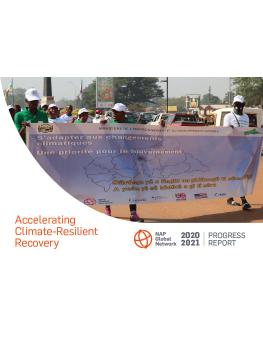
Accelerating Climate-Resilient Recovery

NAP Global Network Progress Report 2020-2021

This progress report on the NAP Global Network’s activities from December 2020 to November 2021 highlights our work to support developing countries’ efforts on national adaptation planning and action.

October 28, 2021

As the COVID-19 pandemic continued through 2021, managing risk and building resilience remained at the top of the global agenda. As countries deal with the climate crisis in tandem with the COVID-19 crisis, the resilience-building measures prioritized in National Adaptation Plans (NAPs) offer a roadmap for resilient recovery that can address these multiple risks.

Report details

Topic
Climate Change Adaptation
Project
NAP Global Network
Impact area
Climate
Publisher
IISD
Copyright
IISD, 2021
Report

Gendered Impacts of COVID-19 on Artisanal and Small-Scale Mining (ASM)

The report includes three cases studies covering the experiences of women in artisanal and small-scale mining (ASM) in Zimbabwe, Peru, and the Philippines before outlining some key principles to achieve a more inclusive and equitable ASM sector globally.

January 17, 2022

The COVID-19 pandemic has had devastating impacts on the livelihoods of many people around the world. Its impacts on informal sectors and in jurisdictions where state reach and support are limited have been all the more damaging. The artisanal and small-scale mining (ASM) sector—which employs nearly 45 million people around the world and indirectly supports approximately 150 million—has been among those hit hardest by the pandemic.

Health impacts on miners and their families have included sickness and, in some cases, death, with many mining communities located in rural areas far from health care or the social safety net of the state. The closure of international borders and imposition of national movement restrictions in many countries disrupted mineral supply chains, creating significant obstacles to trade and a buyer’s market that saw the collapse of mineral prices at the ASM site level.

Against this backdrop, this policy brief focuses on the gendered impacts of COVID-19 on ASM communities. The resounding finding of ASM sector research is that COVID-19 and its related impacts have exacerbated pre-pandemic gender inequalities in the sector, despite women being critical members of the ASM workforce worldwide.

Report

Gender in Mining Governance: An annotated bibliography for artisanal and small-scale mining (ASM)

An annotated bibliography listing key resources for researchers exploring the topic of gender and artisanal and small-scale mining (ASM).

January 17, 2022

The global artisanal and small-scale mining (ASM) sector is estimated to comprise nearly 45 million people worldwide. These women and men produce significant amounts of the world’s minerals, from 20% of the world’s gold to nearly 80% of coloured gemstones.

Both women and men play critical roles in the sector: women were estimated in 2003 to make up nearly 30% of the global ASM workforce, a figure that is much higher in some countries and contexts. Not only do they contribute directly to mineral production, but they are also heavily involved in the provision of services (e.g., mining inputs, mineral processing, etc.) to ASM communities. However, despite the important role they play, women are among the groups that face marginalization in the sector. At the same time, ASM remains an important source of income for many women, who can earn relatively high incomes in the sector.

Despite increased interest over the past decade by the development community in promoting gender equality in the ASM sector, it remains poorly understood in many regions. There are still gaps in gender-responsive research on participation in ASM, impacts of ASM, and evidence-based solutions to overcoming barriers faced by marginalized groups such as women.

This annotated bibliography gives an overview of key resources on the topic of gender and ASM. Resources focus on research conducted in the past decade with the exception of those assessed by the authors to be critically important to understanding the issues around gender and ASM.

Report details

Report

Sustainable Asset Valuation (SAVi) of Forest Restoration in the Brantas River Basin, Indonesia

An example of how forest restoration is used to address land degradation and water availability

In this report, we present a SAVi assessment that quantifies the ecosystem services and economic impacts of the planned reforestation and water retention wells in the Brantas River basin in Indonesia.

January 17, 2022
  • A SAVi valuation of a forest restoration project in Indonesia shows that reforestation has positive net benefits for society that far exceed the costs when externalities are considered.

  • Land restoration and improved water management contribute to climate resilience and increased adaptive capacity for upstream agricultural communities and downstream industrial activity. Reforestation is cheaper than constructing a reservoir with the same water retention capacity.

  • Carbon payments in Indonesia may play a critical role in stimulating investments in nature-based infrastructure, which creates various other benefits, including avoided costs from climate and weather-related events. These avoided costs are not monetized for investors but generate considerable benefits for society.

This Sustainable Asset Valuation (SAVi) assessment shows that the nature-based infrastructure solution of land restoration is more cost effective than building a reservoir for water storage and also provides significant societal benefits. Specifically, over 20 years, these interventions generate net benefits of between USD 104.34 million and USD 131.59 million in avoided flood and erosion damages along with improved water quality, carbon storage, job creation, agroforestry, and bamboo production.

Report details

Report

Investor–State Disputes in the Fossil Fuel Industry

Phasing out fossil fuels is critical to global efforts to tackle climate change, but actions to curb emissions are hindered by protections granted under international investment law. This report analyzes the extent to which investor–state disputes protect foreign investments in fossil fuel projects—and therefore obstruct climate action.

December 31, 2021
  • The fossil fuel industry accounts for almost 20% of the total known investor–state dispute settlement cases across all sectors-making it the most litigious industry in the ISDS system.

  • There has been a recent but growing wave of investment arbitrations initiated by the fossil fuel industry to counteract critical climate measures, such as the phasing out of fossil fuels.

  • Most known ISDS cases related to fossil fuels are decided in favour of investors. The average amount awarded—over USD 600 million—is almost five times the amount awarded in non-fossil fuel cases

As the consequences of burning fossil fuels become increasingly evident, policy-makers across the globe are stepping up their efforts to phase them out and curb emissions. However, under current international investment law, foreign investments in fossil fuel projects are granted special protection. Through a process known as investor–state dispute settlement (ISDS), fossil fuel investors can bring claims to international tribunals regarding regulatory measures adopted by host countries, which they allege breach their investment privileges.

This report analyzes the trends in investor–state disputes initiated by investors in the fossil fuel industry to understand the extent to which this industry relies on ISDS to protect its investments. It identifies and examines 231 known investment arbitrations related to fossil fuels, which account for 20% of the total known ISDS cases across all sectors. The findings suggest that the fossil fuel industry has been using the ISDS system extensively to protect its investments, thereby presenting a major obstacle for countries seeking to phase out fossil fuels and tackle climate change.

Report details

Report

Greater Than the Sum of its Parts

How a whole-of-government approach to climate change can improve Canada's climate performance

Canada's federal government should adopt a whole-of-government approach to climate change. Such an approach can leverage executive leadership to encourage cross-departmental collaboration and integrate climate change into all government policy-making. Canada can learn how to establish an effective whole-of-government approach from the successes and challenges of its peers both at home and abroad. This report examines whole-of-government approaches to climate change from around the world as well as specific lessons learned from three case studies: the United Kingdom, the United States, and British Columbia.

December 20, 2021

Climate change is a complex, cross-jurisdictional issue that requires societal transformation. To meet this challenge, governments must be able to make climate policies that work across sectors, communities, and regional borders. A whole-of-government approach can help to mainstream climate change into policy-making processes.

Effective climate policies that get Canada where it needs to go will require the active involvement of departments as disparate as Finance, Infrastructure, Transport, Natural Resources, Environment and Climate Change, Agriculture and Agri-Food, Crown-Indigenous Relations and Northern Affairs, Public Safety and Emergency Preparedness, Employment and Social Development, and others. This broad reach necessitates a coordinated approach to ensure the coherent implementation of a climate strategy.

Whole-of-government approaches to climate change have become a feature of some national and subnational governments over the last several years, as countries commit to increasingly ambitious measures to curb their greenhouse gas emissions, adapt to climate change, and pursue clean growth strategies. An integrated, coordinated, cross-departmental approach can leverage departmental expertise, reduce policy redundancies, mainstream climate change into all decision making, and create cross-departmental synergies for more effective climate governance.

In this paper, eight countries were surveyed to identify whole-of-government structures and processes dedicated to climate change, and three of these cases (the United Kingdom, British Columbia, and the United States) were analyzed in-depth to determine the benefits and risks of such an approach. Five lessons can be learned for implementing a cohesive and effective whole-of-government approach to climate change:

  1. The success of a whole-of-government climate initiative depends on sustained executive leadership directing departmental priorities and interdepartmental coordination.
  2. An effective whole-of-government climate initiative requires adequate funding, a clear mandate, and the capacity to enact change across departments.
  3. An effective whole-of-government climate initiative requires effective and empowered personnel acting in whole-of-government structures.
  4. The mandates of participating departments must align or be brought into alignment with the mandate of the whole-of-government climate initiative.
  5. A whole-of-government climate initiative should report publicly on its progress and be as transparent as possible about its deliberations, findings, and research.
Report details

Topic
Climate Change Adaptation
Climate Change Mitigation
Governance and Multilateral Agreements
Region
Canada
Impact area
Climate
Publisher
Canadian Institute for Climate Choices
Copyright
Canadian Institute for Climate Choices, 2021
Report

Supporting Marine Fishing Sustainably: A review of central and state government support for marine fisheries in India

This report provides—for the first time—an open-access database of support measures for marine fisheries by the Indian Central Government and four state governments (Andhra Pradesh, Karnataka, Kerala, and Tamil Nadu) based on information from government sources. It recommends an in-depth assessment of the socio-economic and environmental impacts of fuel support; support for deep-sea fishing, mariculture, and vessel modernization; and income support.

December 20, 2021
  • Government support for marine fisheries increased by 43%, from INR 1,550 crore (USD 231 million) in fiscal year (FY) 2016 to at least INR 2,225 crore (USD 316 million) in FY 2019.

  • Key support measures must be evaluated to ensure they contribute to socio-economic well-being in a sustainable way: fuel support, fixed-costs support, and income support.

  • There is a need to improve data transparency and reporting practices in support of marine fisheries to enable more informed and effective policy-making.

Marine fisheries is a key sector in India that provides nutritional security and livelihoods to millions of fishers, many of whom are small scale and low income. This makes India’s fishers particularly vulnerable if the sustainability of fisheries is undermined by overexploitation. Government support is an important factor when examining the social and environmental outcomes of the marine fisheries sector. While some government interventions play a critical role in achieving key public policy objectives such as poverty alleviation, job creation, or resource management, poorly designed support may also fail to assist low-income fishers efficiently, and it can increase fishing effort beyond sustainable levels.

Ensuring that public support to fisheries promotes sustainable development in India thus requires a review of support measures benefiting the sector and their potential implications from social, economic, and environmental perspectives. This report aims to contribute to an informed, evidence-based national discussion in this area by developing an inventory of support measures provided to marine fisheries and identifying specific programs that should be prioritized for detailed evaluation in the future.

The report finds that total estimated government support for marine fisheries increased by 43%, from INR 1,550 crore (USD 231 million) in fiscal year (FY) 2016 to at least INR 2,225 crore (USD 316 million) in FY 2019. Considering only the support measures that would most likely fall within the scope of possible new World Trade Organization rules on fisheries subsidies (i.e., subsidies to wild marine capture fishing and fishing-related activities at sea), the total decreases significantly to INR 829 crore (USD 117 million).

The report identifies three key support categories as priorities for an in-depth assessment of impacts from socio-economic and environmental sustainability perspectives: fuel support; support for deep-sea fishing, mariculture, and vessel modernization; and income support. 

Report details

Report

Sustainable Asset Valuation (SAVi) of Nature-Based Coastal Protection in the Netherlands

An economic valuation of the contribution of the Hondsbossche Dunes sand nourishment to climate adaptation and local development

December 17, 2021

The Hondsbossche Dunes are a nature-based coastal protection solution in the Netherlands. The artificial dune landscape stretches along 7 kilometres of the Dutch North Sea coast.

In this report we present the results of the Sustainable Asset Valuation (SAVi) assessment of the Hondsbossche Dunes project. The assessment quantifies the ecosystem services and economic impacts of the new dune landscape under several flood scenarios and compares this NBI solution to a conventional dike reinforcement.

We find that under all scenarios, the investment in the artificial sand dunes offers greater net benefits than the grey alternative of building a sheet pile wall.

Participating experts

Report

Impact of New Mining Technologies on Local Procurement in the Democratic Republic of the Congo

This case study of DRC considers what the new technologies coming down the pipeline in the mining sector will mean for local suppliers to mining operations and how the government can enhance their opportunities.

December 14, 2021
  • Mining in the DRC is a story of two realities: the estimated two million artisanal miners and some of the world’s most technically advanced industrial mining operations, such as the Kibali gold mine and the Kamoa-Kakula copper project.

  • Our case studies of the Kibali and Kamoa-Kakula operations suggest that local suppliers struggle to fully benefit from the increased uptake of new mining technologies by large industrial mining projects.

  • We highlight outstanding examples of successful Congolese companies supplying goods and services to technologically advanced mines in DRC. Government and other key players have important roles to play in addressing supplier obstacles, for example by helping them access capital, and improving legal and regulatory regimes.

New technologies are changing the face of mining worldwide, with fundamental implications for the number and types of jobs the mine will support, as well as for health and safety, women’s place in mining, greenhouse gas emissions, and the efficiency and viability of mining operations. IGF’s New Tech, New Deal project explored what types of technology we could expect to see, what the impacts might be, and what sorts of government policies are available to best manage the changing relationship between mines and their host countries and communities.

This case study of mining in DRC considers what new technology will mean for local procurementa major element of mining’s contribution to local communities and host countries. It argues that the government needs to help local suppliers take advantage of the opportunities presented by new technologies and avoid the risk of lost business. The study was produced to feed into the final report of the New Tech, New Deal project.

Report

Impact of New Mining Technologies on Large-Scale and Artisanal Mining in Burkina Faso

This case study of Burkina Faso considers what the new technologies coming down the pipeline in the mining sector will mean for labour force and productivity in both the large-scale and artisanal mining in that country.

December 14, 2021
  • With a poverty rate of over 40%, population growth of 3.1%, and a high level of youth unemployment and under-employment, Burkina Faso is heavily reliant on sectors like mining to provide decent jobs.

  • Job losses from automation in large-scale mining will mostly be in low-skilled jobs occupied by locals.

  • New technologies in the artisanal mining sector can bring much-needed improvements in efficiency and environmental performance but may also decimate employment among the most vulnerable: women and youth.

New technologies are changing the face of mining worldwide, with fundamental implications for the number and types of jobs the mine will support, as well as for health and safety, women’s place in the mine, greenhouse gas emissions, and the efficiency and viability of mining operations. IGF’s New Tech, New Deal project explored what types of technology we could expect to see, what the impacts might be, and what sorts of government policies are available to best manage the changing relationship between mines and their host countries and communities.

This case study, based on extensive interviews and research, describes the major impacts that Burkina Faso can expect, covering both the large-scale and artisanal mining sectors. The study was produced to feed into the final report of the New Tech, New Deal project.