Guide

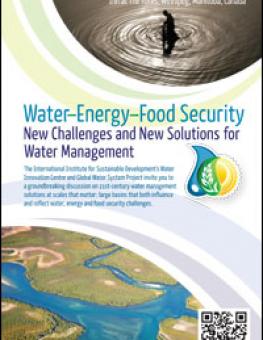
Water-Energy-Food Security: New Challenges and New Solutions for Water Management

February 27, 2012

The International Institute for Sustainable Development's Water Innovation Centre and Global Water System Project invite you to a groundbreaking discussion on 21st-century water management solutions at scales that matter: large basins that both influence and reflect water, energy and food security challenges.

Guide details

Topic
Water
Project
Water Innovation Centre
Impact area
Nature
Publisher
IISD
Copyright
IISD, 2012
Guide

Transparency in the Dispute Settlement Process: Country best practices

In many investor-state arbitrations, it is difficult or impossible even to know that the dispute has been initiated, what the issues and arguments are, and what decisions or awards have been made to resolve the matter.

December 19, 2011

In many investor-state arbitrations, it is difficult or impossible even to know that the dispute has been initiated, what the issues and arguments are, and what decisions or awards have been made to resolve the matter.

This lack of transparency is not something that the treaties require; rather, it is an outcome that arises because the treaties are often silent on issues of transparency and confidentiality in investor-state dispute settlement. Yet this is changing. Concern about the lack of public access to information regarding investor-state arbitrations has been mounting over roughly the past decade, tracking the rise of treaty-based investor-state arbitration itself. In response to those concerns, states have begun to take more direct control over the matter by inserting provisions on transparency directly in their treaties. This bulletin provides an overview of those practices, with a focus on individual agreements negotiated by Canada, the United States, Chile, Singapore, Australia and New Zealand, as well as regional arrangements, such as the North American Free Trade Agreement (NAFTA) and the investment agreement of the Common Market for Eastern and Southern Africa (COMESA), among others. It also reviews a number of selected model agreements. The aim is to illustrate the various approaches countries have increasingly adopted to incorporate transparency into the various stages of the dispute settlement process.

Guide details

Guide

Do good better: The IISD Impact Centre

October 25, 2011

Right now, there are field tested sustainability innovations all around the world that are proven effective but that have never been scaled up and shared.

This brochure presents IISD's proposal to address the challenges of scaling up and replicating success.

Guide details

Impact area
International Governance
Publisher
IISD
Copyright
IISD, 2011
Guide

Global Connectivity Program

September 23, 2011

IISD cannot, by itself, shift the world to sustainability. We cannot connect critical masses of actors with knowledge and with each other without clear, effective policies and protocols for the development and deployment of the underlying "global connectivity system."

Those working toward sustainable development need robust, open, accessible, global communications infrastructures, technologies and services to support the exchange of knowledge and the building of relationships.The Global Connectivity Program considers current trends driving our interest, such as: a world wired to its natural and built environments, a global digital economy and a virtual global village of ideas and influence. With these trends in mind, the Global Connectivity Program is focusing on key areas of concern, which include the transition to Internet Protocol version6 (IPv6), universal affordable access to broadband networks and services and confidence and trust in the online environment. The Global Connectivity Program is committed to keeping economic, social and environmental objectives front of mind when considering these objectives in governance of the Internet and its related technologies.

Guide details

Topic
Technology and Innovation
Publisher
IISD
Copyright
IISD, 2011
Guide

Netley-Libau Nutrient-Bioenergy Project

May 31, 2011

This brochure provides an overview of the award-winning and internationally recognized Netley-Libau Marsh Nutrient-Bioenergy Project and describes research carried out by IISD and its partners the University of Manitoba and Ducks Unlimited Canada at Netley-Libau Marsh.

Research in this large coastal wetland, located where the Red River flows into Lake Winnipeg, has focused on nutrient cycling and cattail biomass harvesting for its multiple co-benefits. Benefits of harvesting include permanent removal of the nutrients from the aquatic ecosystem captured in the harvested plants, biomass for bioenergy production, carbon credits, phosphorus recovery for fertilizer use and habitat improvement. The complete biomass production process is briefly described, including cattail harvesting, drying, baling, compression or densification of biomass into fuel products, combustion for bioenergy production, and collection of the ash to recover stored phosphorus. This brochure describes an innovative approach towards wetland restoration, nutrient capture and reduction of CO2 emissions in an emerging Manitoba bioeconomy.

Guide details

Topic
Water
Project
Water Innovation Centre
Impact area
Nature
Publisher
IISD
Copyright
IISD, 2011
Guide

Summary of CRiSTAL: Community-based Risk Screening Tool - Adaptation & Livelihoods

April 4, 2011

CRiSTAL (Community-based Risk Screening Tool - Adaptation and Livelihoods) is a project planning and management tool that helps users to integrate risk reduction and climate change adaptation into their community-level work.

Developed by the International Institute for Sustainable Development in partnership with the International Union for Conservation of Nature, the Stockholm Environment Institute, and Inter cooperation, the tool provides an analytical framework to help users understand: how climate-related hazards affect a project area and local livelihoods; how people cope with the impacts of these hazards; livelihood resources that are most affected by climate hazards and those that are most important for coping; how project activities affect access to or availability of these livelihood resources; and what adjustments can be made to a project to increase access to or availability of these livelihood resources. The recently updated "Summary of CRiSTAL brochure" explains the objectives, background and application process of CRiSTAL. It also provides contact details and links to further resources on the CRiSTAL website.

Guide details

Topic
Climate Change Adaptation
Impact area
Climate
Publisher
IISD
Copyright
IISD, 2011
Guide

Integrated Environmental Assessment Training Manual

February 4, 2011

Integrated Environmental Assessment (IEA) is defined as the process of producing and communicating future-oriented, policy-relevant information on key interactions between the natural environment and human society.

The methodology underlying IEA has been pioneered and championed by the Global Environment Outlook (GEO), the flagship assessment and reporting process on the status and direction of the global environment of the United Nations Environment Programme (UNEP). GEO is a consultative, participatory, capacity building process and a series of reports, analyzing environmental change, causes and impacts, and policy responses, providing information for decision making at global and sub-global levels.

The Integrated Environmental Assessment Training Manual brochure provides a quick overview of the IEA Resource Book and its use in training programs around the world. The IEA Resource Book will:

  • understand the rationale for undertaking forward-looking, integrated environmental assessment using UNEP's Global Environment Outlook (GEO) approach;
  • understand the importance of mandate for an IEA, options for its governance structure and participatory process, and be able to construct an impact strategy;
  • be familiar with the conceptual and methodological aspects of carrying out the assessment, including the analysis of environmental trends and policies, and the study of policy options in the context of future scenarios;
  • be capable of organizing the process for producing physical and electronic outputs from the IEA; and have the knowledge and skills to set up a monitoring and evaluation process focused on the IEA itself as part of a continuous learning process to improve the assessment.

Guide details

Topic
Measurement, Assessment, and Modelling
Impact area
International Governance
Publisher
UNEP, IISD
Copyright
UNEP, IISD, 2011
Guide

Enhancing resiliency to drought in Kenya's arid and semi-arid lands

August 4, 2010

The case study Enhancing resiliency to drought in Kenya's arid and semi-arid lands provides an overview of a pilot project undertaken in Kenya between 2005 and 2010 that linked together the provision of downscaled weather forecasts, improved agricultural practices, increased access to reliable water sources and the promotion of a revolving microcredit system for women's self-help groups.

Implemented by the Nairobi-based Centre for Science and Technology Innovations in collaboration with the Arid Lands Resource Management Project, the pilot project responded to the fact that drought associated with climate change and climate variability have become more pronounced in Kenya in recent years, adversely affecting the lives and livelihoods of smallholder farmers in its arid and semi-arid lands.

The case study is one of six produced by the Canadian Coalition on Climate Change and Development (C4D) in 2010, along with an accompanying synopsis of lessons learned, as part of its Climate Change Adaptation: Lessons from Canadian NGOs initiative. Drawing directly from the experience of Canadian NGOs and their partners in the global South, the case studies highlight climate change impacts and how local communities are reducing their vulnerability to changing conditions. Financial support for this initiative was provided by the International Development Research Centre.

In 2013 an epilogue to this case study was prepared by Cynthia Awuor. The epilogue highlights how activities that build resilience to climate change at the field level continued after the ACCESA pilot project ended in 2010. It was one of 10 new and updated case studies prepared by C4D in partnership with Canadian NGOs.

The Kenya case study profiles one of three pilot projects being implemented as part of the regional project, Integrating Vulnerability and Adaptation to Climate Change into Sustainable Development Policy Planning and Implementation in Eastern and Southern Africa (ACCESA). This project was implemented by the International Institute for Sustainable Development on behalf of the United Nations Environment Programme. Funding for this project was provided by the Global Environment Facility and the governments of the Netherlands and Norway, and supported by in-kind contributions from the governments of Germany and Kenya. Further information is available here.
Guide details

Region
Kenya
Publisher
C4D
Copyright
Pembina Institute, 2010
Guide

The David Runnalls Fund for Sustainable Development Innovation

June 16, 2010
IISD has set up the David Runnalls Fund for Sustainable Development Innovation to honour the achievements of past President and CEO David Runnalls. The commemorative fund will support and inspire a wide range of sustainable research projects around the world, continuing a tradition of sustainable innovation.

Guide details

Publisher
IISD
Copyright
IISD, 2010
Guide

The IISD Innovator Special 20th Anniversary Edition (June 2010)

June 1, 2010

A historical retrospective celebrating IISD's first 20 years of operation in 20 pages; featuring an in-depth interview with retiring President and CEO David Runnalls, a farewell message from Mr. Runnalls, tributes to Mr. Runnalls from colleagues and friends, a message from IISD Board Chair Daniel Gagnier, excerpts from the sustainability and IISD timelines, IISD in words and pictures—a pictorial history of the Institute from 1990 to 2010—PLUS a forecast for the future: what the next 20 years will bring.

Guide details

Publisher
IISD
Copyright
IISD, 2010