Guide

Guide for Small-Scale Producer Engagement

Effective engagement with small-scale producers is key to achieving fair and lasting change in value chains. This guide offers practical support for organizations that promote sustainable market-based initiatives to strengthen how they listen to, work with, and learn from producers across different contexts.

March 31, 2026

Key Messages

  • Achieving credible and scalable sustainability outcomes requires sustained, inclusive engagement with the small-scale producers whose livelihoods and landscapes are directly affected.

  • The guide provides organizations with practical entry points and tools to broaden and deepen producer engagement, reach new audiences, navigate power asymmetries, and strengthen local relationships.

  • Effective producer engagement is iterative and context-specific, requiring continuous learning, adaptation, and collaboration.

  • Fostering learning and exchange within organizations, across partnerships, and among sustainability systems can accelerate progress toward more equitable and sustainable market transformation.

Co-developed with ISEAL Alliance, this guide identifies tools and approaches that can support voluntary sustainability standards, certification schemes, and other market-led sustainability initiatives and their partners. It focuses on helping organizations know where to start and how to continue to better understand producer priorities, build trust, and support more meaningful participation in decisions. 

The guide is structured around five core strategic objectives essential for scaling reach and impact:

  • identifying who to engage: understanding the full landscape of actors, including household members, youth, and marginalized producers typically excluded from formal networks.
  • understanding priorities and constraints: grounding initiatives in the lived realities and capacities of producers to ensure support programs create enabling conditions rather than additional burdens.
  • gathering input and building trust: implementing transparent, accessible, and responsive avenues for input that strengthen accountability between producers and market actors.
  • supporting meaningful influence: creating opportunities for producers to co-design initiatives and shape decisions that affect their lives.
  • sustaining relationships: moving toward long-term collaboration and learning, supported by frameworks for data equity and sovereignty.

Guide details

Topic
Responsible Business
Standards and Value Chains
Project
State of Sustainability Initiatives
Impact area
Sustainable Economies
Publisher
ISEAL Alliance
Copyright
ISEAL Alliance, 2026
Guide

Tracking Progress on Sustainable Jobs in Canada

A how-to guide

This guide supports monitoring and accountability for federal sustainable jobs efforts. Building on earlier research, it offers practical guidance on indicators and monitoring frameworks, draws on international interviews and case studies, and provides a detailed review of 19 proposed indicators to support transparent, evidence-based just transition policy in Canada.

February 26, 2026

Policy Recommendations

  • Tracking progress on sustainable jobs is essential to sustaining public and worker support for the transition and informing the Sustainable Jobs Action Plan.

  • Effective monitoring strengthens accountability, improves decision making, and enables governments to course-correct when progress is off track.

  • Canada does not need to start from scratch. This guide draws on interviews with experts in countries at the forefront of just transition monitoring, including Scotland, South Africa, and Ireland.

  • Key recommendations from the report emphasize strong data collection and coordination, sharing lessons learned, transparency, and clear public communication.

Protecting and strengthening the well-being of workers and communities through the economy-wide transition away from fossil fuels is an incredibly complex challenge. Canada's federal sustainable jobs legislation sets up some key governance mechanisms to advance an equitable transition and create good, long-term jobs in low-carbon industries. Ensuring that policies are effectively progressing toward sustainable jobs goals and learning lessons to course-correct along the way are essential.

Guide details

Topic
Just Transition
Region
Canada
Impact area
Social Equity
Publisher
IISD
Copyright
IISD, 2026
Guide

A Day in the Life of a Protected Area Manager

Navigating climate change impacts on Belize's ecosystems and communities using nature-based solutions

Protected area managers in Belize are increasingly navigating the impacts of climate change on ecosystems while supporting local communities to adapt. These comic booklets follow the day-to-day lives of two fictional protected area managers working in Belize's marine and terrestrial protected areas, highlighting key climate change impacts and showcasing how communities are responding through nature-based solutions.

January 13, 2026

Key Messages

  • Belize is experiencing multiple climate hazards across marine and terrestrial ecosystems, including rising temperatures and stronger hurricanes.

  • Protected area managers in Belize play a critical role in supporting ecosystems and local communities to adapt to climate change.

  • Nature-based solutions for adaptation can reduce climate change impacts while delivering benefits for both communities and biodiversity.

  • Nature-based solutions help people and ecosystems thrive together.

Climate change is impacting Belize's ecosystems and local communities, including those that depend on natural resources in and around protected areas, such as the Maya Forest Corridor and Glover's Reef Marine Reserve, for their livelihoods. 

These comic booklets follow the lives of two fictional protected area managers working in Belize's marine and terrestrial ecosystems. They highlight the impacts of climate change on ecosystems and communities and show how protected area managers support communities to adapt using climate adaptation strategies such as nature-based solutions. 

The booklets build on Belize's Climate Risk Profile, developed under the Climate Adaptation and Protected Areas Initiative, offering a practical guide to understanding climate impacts and how communities and protected areas are adapting. The content of the booklets was shaped through close collaboration, as well as invaluable insights and feedback from the initiative’s implementing partner, WCS Belize.

Guide

A Step-by-Step Guide for Governments to Prepare Fossil Fuel Subsidy Inventories

The Coalition on Phasing Out Fossil Fuel Incentives Including Subsidies (COFFIS) was launched at the 28th United Nations Climate Change Conference (COP 28) in 2023, with 17 countries committing to work on fossil fuel subsidy reforms. Creating transparent and comprehensive inventories of fossil fuel subsidies is an important step toward reform. This guidance paper is intended to assist COFFIS members and other governments in producing such an inventory by providing actionable inputs into the process. 

December 17, 2025

Recommendations

  • Fossil fuel subsidy inventories should be led by agencies that can initiate legislative or regulatory proposals for reform and involve all government agencies concerned with fossil fuel subsidies, under a whole-of-government approach.

  • Inventories should be consistent with the subsidy definition in Article 1.1 of the WTO ASCM and include additional elements as appropriate. It’s preferable to use internationally recognized terminology to categorize subsidy measures, to ensure better communication and knowledge-sharing.

  • It is crucial that inventories provide an estimate of the fiscal costs of subsidies to governments, including of government revenue foregone.

  • Inventory updates should be conducted on an annual basis to demonstrate progress and further improve the quality of subsidy data.

Every year, governments worldwide spend at least USD 1 trillion dollars on subsidies to fossil fuels. This spending puts a strain on government budgets, contributes to climate change and air pollution, and distorts the markets in favour of fossil fuels and against other, cleaner energy sources. 

As early as 2009, G20 leaders agreed to phase out “inefficient” fossil fuel subsidies over the medium term, and at COP 26, parties to the United Nations Framework Convention on Climate Change called for phasing out “inefficient fossil fuel subsidies.” However, these commitments have not translated into tangible progress on subsidy reform. 

In response, COFFIS was launched at COP 28 in 2023 and has since seen 17 countries committing to work on fossil fuel subsidy reforms both collectively and through domestic action. In their Ministerial Statement launching the coalition, COFFIS member states committed to providing transparency on their fossil fuel subsidies by publishing an inventory.

Creating transparent and comprehensive inventories of fossil fuel subsidies is an important step toward reform. This guidance paper is intended to assist COFFIS members and other governments—including at the subnational level—in producing such an inventory. 

Countries should follow the following steps in compiling their inventory: 

  • Step 1. Apply a whole-of-government approach
  • Step 2. Work under a comprehensive subsidy scope and definition
  • Step 3. Choose an appropriate method to measure subsidies
  • Step 4. Consider evaluating subsidy measures from an environmental or otherwise broader socio-economic perspective
  • Step 5. Plan for transparent and regular publication and update of the inventory 

For countries that do not yet have fossil fuel subsidy inventories, compiling one is a low-hanging fruit for improving transparency. Even a simple inventory can trigger important conversations, and an inventory based on the best practices can both unlock pathways for reform action plans and serve as an effective communication tool with different audiences.

Guide details

Topic
Climate Change Mitigation
Energy
Subsidies
Impact area
Climate
Publisher
IISD
Copyright
IISD, 2025
Guide

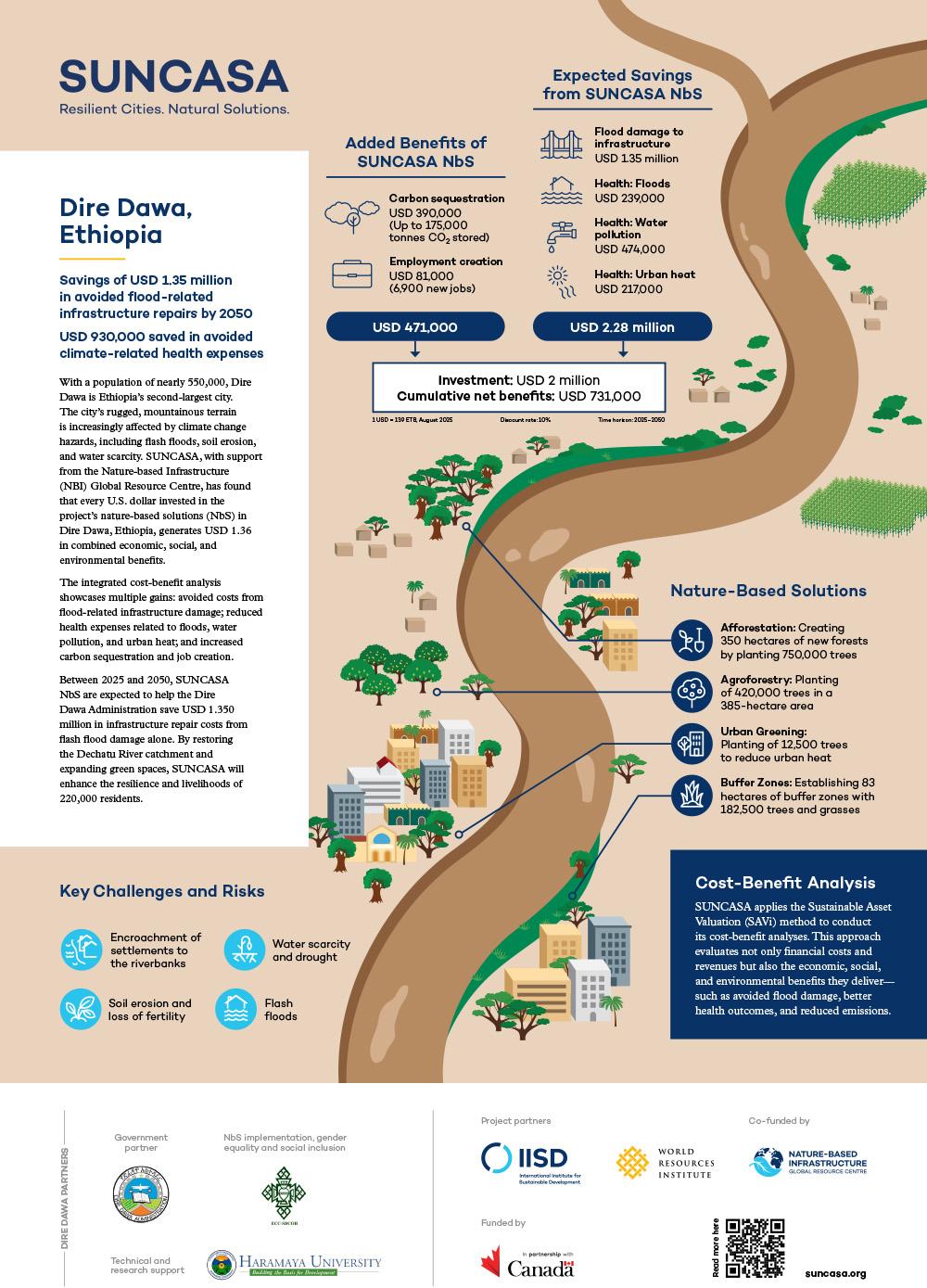
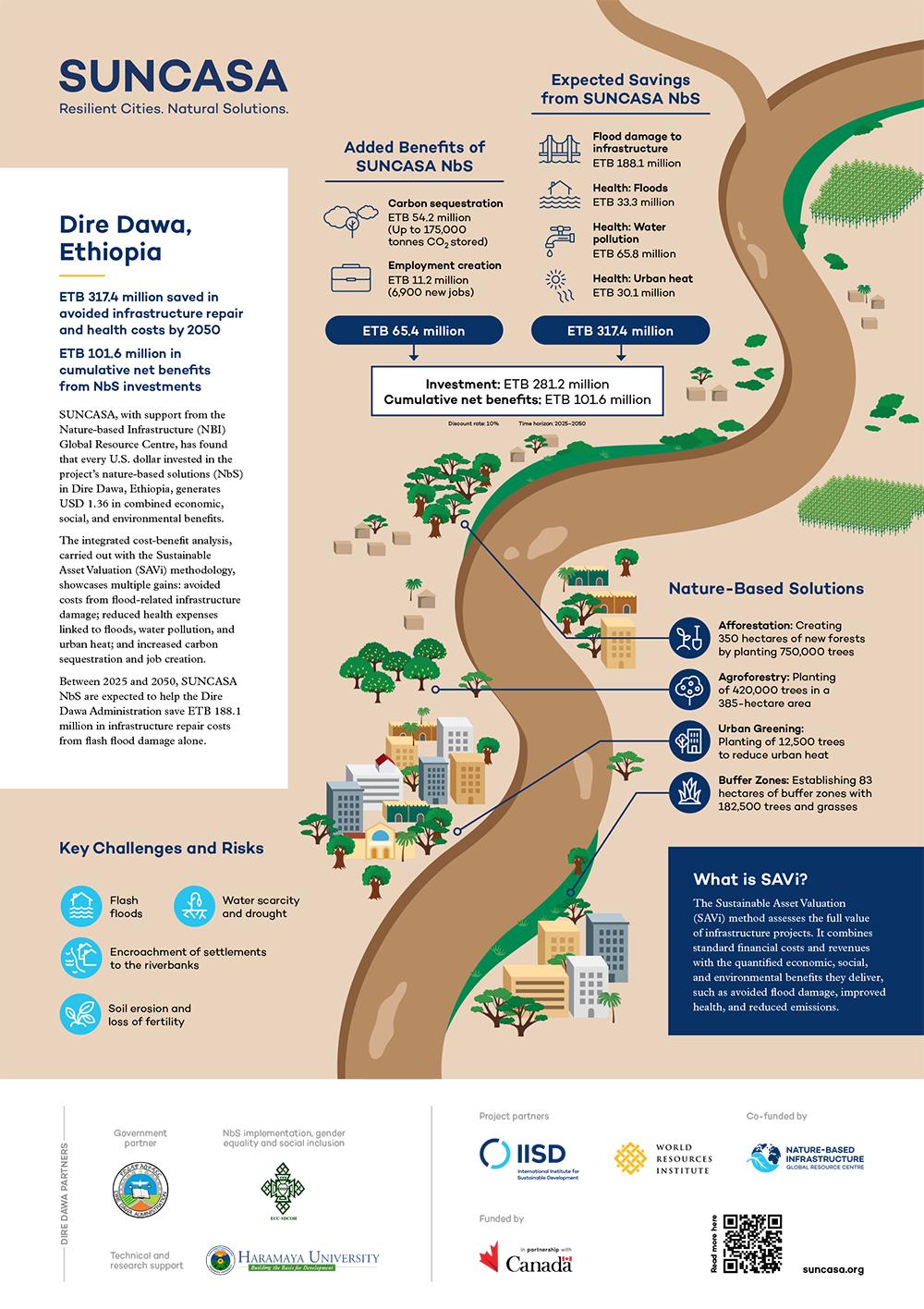
SUNCASA Integrated Cost-Benefit Analysis for Dire Dawa, Ethiopia | Infographic

Dire Dawa, Ethiopia, faces severe climate risks from floods, soil erosion, and water scarcity. These infographics show the impacts nature-based solutions (NbS) could have on the region based on an integrated cost-benefit analysis.

November 20, 2025

In Dire Dawa, Ethiopia, flash floods, soil erosion, and water scarcity pose serious climate threats, especially for people living in flood-prone urban and rural areas. Through the SUNCASA initiative, the International Institute for Sustainable Development, the World Resources Institute (Africa), and local partners and communities are restoring the Dechatu River catchment with NbS to reduce flooding and erosion, enhance groundwater recharge, and expand agroforestry and urban green spaces. 

A new integrated cost-benefit analysis, which follows the Nature-Based Infrastructure Global Resource Centre's Sustainable Asset Valuation (SAVi) methodology, highlights the tangible impacts of these NbS interventions. By 2050, they are projected to

  • save USD 1.35 million in avoided flood-related infrastructure damage,
  • avoid USD 930,000 in climate-related health costs, and
  • create nearly 6,900 jobs.

SUNCASA's NbS are strengthening resilience for over 220,000 people in one of Ethiopia's most climate-vulnerable regions. The infographics offer a visual overview of the long-term benefits of SUNCASA's NbS in Dire Dawa, with values presented in U.S. dollars and Ethiopian birrs. Read the full report here.


SAVi assessment of Dire Dawa, Ethiopia (USD) infographic.
SAVi assessment of Dire Dawa, Ethiopia (ETB) infographic.
Guide

From Commitment to Implementation

Guidance for governments on fossil fuel subsidy phase-out plans

This publication provides practical, politically informed guidance to help governments design and implement fossil fuel subsidy phase-out plans. It outlines a three-step framework—whole-of-government coordination, subsidy categorization, and implementation planning—to support credible, time-bound, and country-specific reform strategies. 

November 13, 2025

Policy Recommendations

  • Governments need clear, time-bound fossil fuel subsidy phase-out plans to move from commitments to implementation and ensure predictable, accountable reform.

  • A whole-of-government approach—spanning finance, energy, social, and sector ministries—is essential for coherent planning, stakeholder engagement, and durable fossil fuel subsidy reform.

  • Fossil fuel subsidies should be categorized by reform timelines—quick phase-out, phase-out with a robust strategy, or time-limited exemption—using transparent criteria on impacts and feasibility.

  • Implementing fossil fuel subsidy phase-out plans requires clear responsibilities, mitigation measures, and regular progress reviews to secure public trust, avoid reversals, and deliver lasting benefits.

Despite long-standing global commitments, progress on reform has been slow, often hindered by political pressures, institutional fragmentation, and the absence of actionable roadmaps. This publication offers clear, practical guidance to translate commitments into implementation through robust fossil fuel subsidy phase-out plans. 

The guidance is grounded in country-specific realities and is structured around a three-step framework. Step 1 sets out how to establish a whole-of-government approach that ensures coherent planning, alignment with national priorities, and effective stakeholder engagement. Step 2 introduces a systematic method for categorizing subsidies by phase-out timelines—quick phase-out, phase-out with a robust strategy, and time-limited exemptions—supported by a decision tree that evaluates energy security, socio-economic and environmental impacts, and political feasibility. Step 3 outlines how to turn these classifications into concrete action plans with clear responsibilities, milestones, mitigation measures, and annual review cycles. 

This guidance equips governments with a structured, adaptable, and politically informed approach to make fossil fuel subsidy reform a success. It supports early wins, builds public trust, and helps avoid reversals by embedding reforms into stable policy processes.

Guide details

Topic
Energy
Subsidies
Impact area
Climate
Initiatives
COFFIS | Coalition on Phasing Out Fossil Fuel Incentives Including Subsidies
Publisher
IISD
Copyright
IISD, 2025
Guide

Conflict-Sensitive Nature-Based Solutions

Promoting resilience, nature, and peace

When nature-based solutions (NbS) for climate adaptation do not consider the broader social, economic, and environmental context, they can unintentionally worsen existing conflicts, tensions, and grievances. This infographic on conflict-sensitive NbS highlights why integrating conflict sensitivity and peacebuilding into NbS for climate adaptation is essential to strengthen resilience, promote peace, and guide practitioners on how to do it effectively.

October 8, 2025

Key Messages

  • When NbS for adaptation do not consider the broader context, they risk creating new or worsening existing tensions, grievances, and conflicts.

  • Conflict-sensitive NbS for adaptation are designed and implemented to increase the climate resilience of ecosystems and communities in a way that considers the causes, actors, dynamics, and impacts of conflict.

  • Conflict-sensitive NbS for adaptation are specifically designed to minimize conflict risks and enhance peacebuilding opportunities.

  • Conflict-sensitive NbS for adaptation can help people and ecosystems thrive together.

Guide details

Guide

Business Plan Template for Agricultural Cooperatives in Cambodia to Advance Sustainability

This guide supports agricultural cooperatives (ACs) and their partners in Cambodia to develop business plans that strengthen sustainability and resilience.

October 6, 2025

Key Messages

  • This template helps cooperatives and supporting organizations improve operations, integrate sustainability, and align with the Association of Southeast Asian Nations' guidelines on responsible investment and voluntary sustainability standards.

This guide supports ACs and their partners in Cambodia to develop business plans that strengthen sustainability and resilience. 

ACs were created by Cambodia's Ministry of Agriculture, Forestry, and Fisheries to help farmers shift from traditional family-based farming to stronger, more competitive enterprises. While Cambodia has 1,200 cooperatives with 170,000 members, less than a fifth are performing well due to challenges such as limited leadership, financing, competitiveness, and climate risks. 

A business plan is a key tool to address these barriers. This template helps cooperatives and supporting organizations improve operations, integrate sustainability, and align with the Association of Southeast Asian Nations' guidelines on responsible investment and voluntary sustainability standards—unlocking new opportunities for markets and investment.

Guide details

Topic
Standards and Value Chains
Project
State of Sustainability Initiatives
Impact area
Social Equity
Sustainable Economies
Publisher
IISD
Copyright
IISD, 2025
Guide

IISD Strategic Plan 2025–2030

IISD's Strategic Plan 2025–2030 is a roadmap that will guide our organization as we solve today's greatest sustainable development challenges in an increasingly complex and dynamic world.

September 15, 2025

This plan is the result of profound reflection, collaborative discussions, and a shared commitment to ensuring IISD remains a leader in our field. 

It focuses on five key areas of sustainable development: climate, nature, social equity, sustainable economies, and international governance. Within these, we outline top priorities in specific sectors where we see the greatest potential to make an impact, allowing us to harness the full extent of our expertise and address the root causes of problems rather than only providing end-of-the-line solutions. There is plenty of overlap, but that’s intentional: complex challenges demand integrated, multidimensional solutions, and that's where IISD excels. 

Above all, this represents a commitment to action. It positions us to lead, innovate, and work together to create a world where people and the planet thrive.

Guide details

Publisher
IISD
Copyright
IISD, 2025
Guide

A Guide to the Global Agreement to End Plastic Pollution

Years of negotiations between countries to agree on a treaty to tackle the scourge of plastic pollution are coming to a head in August 2025 in Geneva—but an ambitious treaty is far from certain.

July 25, 2025

Key Messages

  • All states agree plastic waste management is a priority. The challenge lies in ensuring waste is managed in an environmentally sound manner. Areas for possible convergence include container deposit schemes for highly recyclable products like drink bottles and engineered landfills.

  • Perhaps the most contentious aspect of the talks is the proposed global production reduction target. While some states support ambitious targets, others are concerned about the economic impact of reducing plastic production, which would hit profits and livelihoods.

  • By targeting well-documented and widely recognized chemicals of concern in single-use plastic products, some believe the treaty can achieve early wins in reducing the impact of harmful chemicals.

  • Longer-lasting plastic products result in less plastic waste over time. By designing products that are more durable, reusable, refillable, refurbishable, repairable, and (where environmentally sound) recyclable, the tide of single-use plastic waste can be stemmed.

Plastic pollution has emerged as one of the most pressing environmental crises of our time, affecting ecosystems, human health, and economies worldwide. Recognizing the urgency of this issue, countries at the United Nations Environment Assembly adopted a resolution in March 2022 to initiate negotiations on an international legally binding instrument to end plastic pollution, including in the marine environment. The resolution established an Intergovernmental Negotiating Committee (INC), which has met multiple times to try to determine an agreement.

This guide serves as a resource for understanding the ongoing negotiations, key issues at stake, and roles of different stakeholders in shaping the future agreement. It provides insights into the political, scientific, economic, and legal dimensions of the treaty process, drawing from past multilateral environmental agreements and the lessons learned from the INC sessions. The guide is structured to help policy-makers and stakeholders navigate the complexities of these talks and contribute meaningfully to an effective treaty on plastic pollution.

Written in the intersessional period between INC-5.1 in Busan and INC-5.2 in Geneva, the report unpacks the history of the talks to end plastic pollution, reviews key parts of the instrument under discussion, and identifies stakeholders shaping the talks. Finally, it offers negotiating "tips and tricks" to help those at the final INC take these discussions over the finish line.

Guide details