Press release

New initiative taps into the power of nature to build resilience and protect biodiversity amid climate crisis

September 8, 2023

September 8, LUSAKA—The three-year Climate Adaptation and Protected Areas (CAPA) initiative, launching today in Zambia’s capital, will use nature-based solutions to support local communities in adapting to climate change while safeguarding critical ecosystems in and around protected areas in the Kavango-Zambezi and Greater Virunga landscapes in sub-Saharan Africa, as well as in Belize and Fiji.

“CAPA will bridge the gap between protected areas management and climate change adaptation planning, while involving women and marginalized groups at all stages to ensure an inclusive approach,” said Anne Hammill, Associate Vice President, Resilience, at IISD.

Through the CAPA initiative, IISD, along with the World Wide Fund for Nature (WWF) and the Wildlife Conservation Society (WCS), with support from Global Affairs Canada, will work with local communities, traditionally marginalized groups, women, and national and local authorities to design and implement concrete gender-responsive, conflict-sensitive, nature-based solutions for adaptation that can be implemented right away.

WWF Zambia Country Director, Nachilala Nkombo, says “CAPA represents a valuable opportunity to enhance climate change adaptation measures in the Kavango-Zambezi landscapes. By working closely with local communities, we can develop solutions that not only address climate change impacts but also empower communities to actively participate in safeguarding Zambia’s natural heritage.”

CAPA will implement a wide range of activities in each site to achieve its objectives, such as

  • establishing native tree nurseries to support reforestation efforts, restocking community game ranches with native wildlife to restore ecological balance, and initiating the establishment of community forests in Zambia; 
  • supporting restoration activities of agricultural lands adjacent to protected areas, through soil and water conservation, in Uganda; 
  • promoting sustainable fisheries and establishing marine protected areas while supporting the development of climate-resilient alternative livelihood options in two communities in Fiji;
  • establishing financial protections for marine reserves in the event of natural hazards in Belize.

“Through the CAPA initiative, Canada reaffirms its commitment to climate action and supporting sustainable development in international contexts,” said Honourable Ahmed Hussen, Canada’s Minister of International Development, at today’s launch event. “We are proud to partner with organizations like IISD, WWF, and WCS in implementing gender-responsive approaches that ensure inclusive and equitable outcomes for all.”

“CAPA aligns with Zambia’s commitment to sustainable tourism development and the conservation of our natural resources,” said Honourable Rodney Sikumba, Zambia’s Minister of Tourism. “By establishing community forests and engaging with traditionally marginalized groups, we can ensure that local communities are at the forefront to drive the climate adaptation agenda, fostering long-term resilience in line with our global goals on adaptation commitments.”

Media Contacts

For further information or interview requests, please contact:

Hazel Zulu

Senior Liaison Officer, Canadian High Commission

Email: [email protected]

Mobile: +260 979 473 284                                   

Benetria Milambo

Communications Coordinator, WWF Zambia

Email: [email protected]

Mobile: +260 772 099 733

Marie Royer

Communications Officer, IISD

Email: [email protected]

 

Climate Adaptation and Protected Areas Initiative

The Climate Adaptation and Protected Areas (CAPA) Initiative will use nature-based solutions to strengthen climate resilience and protect biodiversity in and around protected areas in the Kavango-Zambezi and Greater Virunga landscapes in sub-Saharan Africa, as well as in Belize and Fiji.

Through this project, IISD along with the World Wide Fund for Nature (WWF) and the Wildlife Conservation Society (WCS), with support from Global Affairs Canada, will work with local communities, traditionally marginalized groups, women, and national and local authorities to design and implement concrete gender-responsive, conflict-sensitive, nature-based solutions for adaptation in and around protected areas and critical landscapes.

The CAPA Initiative seeks to:

  • tap into the potential of nature-based solutions to support local communities in adapting to climate change while safeguarding critical ecosystems and biodiversity in and around protected areas;

  • better integrate climate adaptation considerations into the management of protected areas; and

  • allow more women, in all their diversity, and marginalized groups to participate in the design and implementation of nature-based solutions for adaptation and in climate-resilient management plans for protected areas.​

The project is being implemented across four landscapes:

  • In Belize it will address water security concerns, improve biodiversity and hydrological functions, stabilize and enhance degraded soil and provide ecosystem services to local communities.​

  • In Fiji it will promote sustainable fisheries, safeguard locally managed marine areas, train local communities, preserve functional and healthy ecosystems and improve flood mitigation, nutrient cycling, and the provision of downstream ecosystem benefits to coral reefs and adjacent coastal habitats.​

  • In the Greater Virunga Landscape (Uganda) it will focus on nature-positive livelihood interventions and restoration of agricultural lands adjacent to protected areas and the establishment of tree nurseries and beekeeping.

  • In the Kavango-Zambezi Landscape (Angola, Namibia, Zambia, Zimbabwe) it will promote the restoration of forest cover, restocking wildlife, strengthening indigenous forest systems and stabilizing headwater, riverine, and functions on natural lagoons wetlands to enhance ecosystem integrity and biodiversity.​

Planting for Resilience

Scaling Up the Adoption of Ecosystem-Based Adaptation Using Behaviour-Centred Design: The case of vetiver grass for riverbank erosion control in Fiji


Planting for Resilience is a research initiative that explores how to incentivize the adoption of climate adaptation solutions and the implications for developing and implementing climate policies that are informed by behavioural science.
 

Adapting to climate change requires shifts at the individual, organizational, and collective levels—from what we eat, how we consume, and how we commute to how we manage our ecosystems, and much more. However, the role of behaviour change in the field of climate adaptation has largely been overlooked and oversimplified. The latest science on behavioural change reveals that knowing and caring about an issue does not automatically drive behavioural change. This means that, in addition to securing funding and raising key stakeholders’ awareness of the socio-economic and environmental value of climate adaptation solutions, more attention is needed to addressing behavioural barriers at individual and collective levels.
 

This initiative focuses on one approach that responds to climate change impacts and risks: Ecosystem-based Adaptation (EbA). EbA includes protecting, restoring, and enhancing ecosystem services while improving the resilience of communities and livelihoods. Through this initiative, we explore a specific case of EbA: the adoption of vetiver grass for riverbank rehabilitation to reduce flood damage in Fiji.
 

The initiative brings together climate adaptation specialists from IISD, behaviour science experts from Rare (the Center for Behavior and the Environment), and policy- and decision-makers from the Fijian Ministry of Waterways and the Ministry of Economy’s Climate Change Division.
 

The Planting for Resilience project is made possible with the financial support of the Global EbA Fund. 

Project details

IISD in the news

How Fiji Does Climate Adaptation: Actions Speak Louder In Virtual Reality

Over here in the US, much of the climate adaptation talk has to do with the familiar topic of infrastructure. Massive structures of concrete and steel are only part of the solution, though. CleanTechnica caught wind of a United Nations project that leverages virtual reality to communicate the nuances of climate adaptation, and they have chosen an interesting location to explore: the islands of Veidrala, Narikoso, and Lekanai in Fiji.

June 15, 2022

IISD in the news details

Topic
Climate Change Adaptation
Region
Fiji
Project
NAP Global Network
Impact area
Climate
Brief

How Fiji Is Using the National Adaptation Plan (NAP) Process to Scale Up Ecosystem-Based Adaptation (EbA)

June 1, 2021

Since launching it’s National Adaptation Plan (NAP) in 2018, Fiji has begun implementing the adaptation measures prioritized through its NAP process, notably scaling up Ecosystem-based Adaptation (EbA) efforts—which is a type of Nature-based Solution (NbS).

This briefing note provides an overview of how the Fijian government is approaching this task and share lessons for other countries seeking to use the NAP process to scale up EbA.

Brief details

Topic
Nature-Based Solutions
Climate Change Adaptation
Region
Fiji
Project
NAP Global Network
Impact area
Climate
Publisher
IISD
Copyright
IISD, 2021
Success story

Sink, Swim … or Fight Back

Helping countries adapt to climate change is central to the mission of the NAP Global Network, hosted by IISD.

August 5, 2020

When Cyclone Winston hit Fiji in February 2016, it killed dozens of people, left thousands homeless, devastated infrastructure, and caused huge economic losses.

“Winston taught us all a lesson and had an indelible impact on the national psyche,” said Josaia Voreqe Bainimarama, Fiji’s Prime Minister.

“We know that because of the stronger and more frequent storms caused by climate change, it is only a matter of time before Fiji is struck again.” 

Fiji Prime Minister Frank Bainimarama delivers a speech

Prime Minister Bainimarama has prioritized climate adaptation for his country. (Photo: UN Geneva CC BY-NC-ND 2.0)

After Winston hit Fiji, the government quickly prioritized creating a National Adaptation Plan or NAP. Adaptation planning enables countries to identify and address their medium- and long-term priorities for adapting to climate change.

Through funding from the governments of Canada and the United States, the NAP Global Network helped Fiji create a national plan to make the country more climate resilient. The Fijian government worked with stakeholders in a participatory process to prioritize 160 actions in key sectors like health and food security. The NAP Global Network, hosted by IISD, is now supporting Fiji to put this plan into action.

It is only a matter of time before Fiji is struck again.

Josaia Voreqe Bainimarama, Prime Minister of Fiji

Fijians recognize that having the means to adapt is not just a policy objective—it’s a matter of survival.

Climate adaptation is one of two main responses to climate change: the other is climate mitigation. Mitigation is about lessening the flow and concentration of heat-trapping greenhouse gases in the atmosphere by reducing emissions and capturing and sequestering carbon.

Adaptation, on the other hand, is about adjusting to the impacts that are already being observed or that are anticipated in future. Put into practice, adaptation can take different forms: everything from building sea walls to guard against rising water levels to behaviour changes like using less water or planting crops that are drought- or flood-resistant.

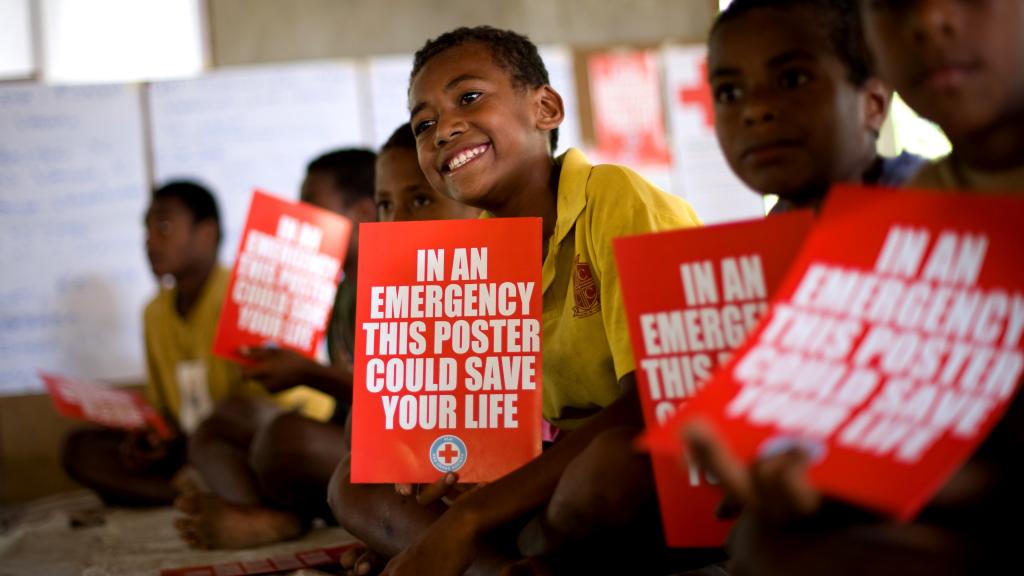
Students in a classroom in Fiji hold disaster risk reduction posters
Photo: UN DRR (CC BY-NC-ND 2.0)

As COVID-19 takes its toll on global economies, Fiji is no exception—its economy is expected to shrink by almost 5% this year due to travel restrictions. Tourism, responsible for 40% of the country’s GDP, has ground to a halt. Climate impacts have not relented either—in April, Cyclone Harold slammed into Fiji, destroying buildings and flooding towns.

NAPs are focused on climate change, but since climate change interacts with so many aspects of societies, economies, and ecosystems, preparing for its impacts often involves simultaneously addressing many issues that shape our lives. This makes the NAP process a valuable tool for responding to other threats, including fast-moving viruses like the one that causes COVID-19.

And that is why having a NAP is so important. As a threat multiplier, climate change will reverse development gains unless Fiji has the systems and capacities in place to anticipate, withstand, and recover from its impacts.

“We all need to focus as nations on our own adaptation measures,” said Bainimarama at the 2018 launch of the National Adaptation Plan. “I want to acknowledge and thank the NAP Global Network for providing us with the technical and financial support to develop this blueprint for our adaptation efforts.”


Downed electrical poles after a storm in Fiji

(Photo: Department of Foreign Affairs and Trade CC BY 2.0)

Success story details