This workshop builds on two previous Quality Assurance Workshops that took place in May and November 2025. The objectives of this workshop are to:
move forward with a roadmap for adopting a nation-wide Quality Assurance Program (QAP) and Hazard Analysis Critical Control Points (HACCP) requirements for safe production of live edible oysters;
share updates on regulatory frameworks, including the Fiji Aquaculture Development Act, licensing, export permits, and public health auditing processes;
strengthen coordination between farmers, regulators, laboratories, and technical partners to support compliance and market access.
AQUA-Pearl team members from J. Hunter Pearls, Wildlife Conservation Society Fiji, Pacific Community and IISD will represent the project. An interactive workshop will explore the advancements on HACCP planning for this project, updates on the Fiji Aquaculture Development Act, and what a roadmap for a nation-wide QAP and HACCP requirements could look like for bivalve aquaculture.
Speakers
Sakiusa Kiti, AQUA-Pearl consultant
Veronica Lo, IISD
Api Cegumalua, HACCP Consultant
Justin Hunter, J. Hunter Pearls
Taina Rauvala, Fiji Ministry of Health
Sanjeet Singh, Fiji Ministry of Health
Prashneel Chandra, Fiji Ministry of Fisheries
Rosi Batibasaga, Wildlife Conservation Society Fiji
Taina Rauvala, Ministry of Health
Wayne O’Connor, Australian Centre for International Agricultural Research
Samantha Nowland, Australian Centre for International Agricultural Research
Conflict-Sensitive Conservation in a Changing Climate
On December 9, the International Institute for Sustainable Development (IISD) hosted a webinar to explore the links between climate change, biodiversity loss, and conflict, and the role that protected areas can play in addressing these challenges. The session unpacked what conflict-sensitive conservation is, why it matters, and how to design and implement effective interventions. Drawing on the panel’s expertise and real-world examples, the webinar also highlighted how conflict-sensitive approaches can help people and ecosystems thrive together in times of dramatic change.
December 9, 2025 2:00 pm - 3:00 pm GMT/UTC
(Open to public)
About the Event
Protected areas are increasingly seen as an essential tool in tackling the twin crises of climate change and biodiversity loss. In addition to being critical refuges for flora and fauna, the health of these ecosystems and the services they provide underpins the resilience of local populations and economies.
Unfortunately, the impacts of both climate change and ecosystem degradation are rapidly changing protected areas and the context in which decisions on their management and conservation are made. Conservation planning and interventions have always been linked to conflict management, given that they are typically concerned with competing visions of natural resource control, access, and use. This is not necessarily a bad thing; such conflicts, if handled peacefully, can often lead to positive change. Climate change and ecosystem degradation are, however, complicating this context and can often be contributing factors in the rise of local resource-, water-, and land-based conflicts, tensions, and grievances.
As such, it is imperative that conservation interventions consider the broader social, economic, and environmental context in which they are designed, implemented, and evaluated, so that they do not unintentionally create new conflicts or exacerbate existing ones. This involves applying a conflict-sensitive approach to conservation matters.
Conflict-sensitive conservation encompasses activities designed and implemented to protect and conserve ecosystems and landscapes in a way that considers the causes, actors, dynamics, and impacts of conflict.
This 1-hour webinar:
explored the links between climate change, biodiversity loss, and conflict, and the role of protected areas in addressing the climate and biodiversity crises;
introduced conflict-sensitive conservation, exploring the benefits it offers to both people and nature, and why it is a vital component of both biodiversity protection and climate adaptation;
showcased real-world examples of what this approach looks like in practice, including the conservation efforts in the Climate Adaptation and Protected Areas (CAPA) initiative (with a focus on human–wildlife conflicts driven by drought in Zambia);
highlighted a Conflict-Sensitive Conservation e-learning course and some practical tips for designing and implementing conflict-sensitive conservation activities and interventions.
Moderator
Onyinye Oguntoye, Communications Officer, IISD
Speakers
Alec Crawford, Director, Nature for Resilience, IISD
Nalucha Nganga, Country Director, World Wide Fund for Nature (WWF) Zambia
Restoring Wetlands and Weaving Tradition: How Fijian coastal communities are building climate resilience
From reviving kuta weaving to patrolling coastal waters, Fijian communities are taking action to safeguard biodiversity, prevent illegal fishing, and build resilience in the face of climate change.
November 21, 2025
Most of Fiji’s coastal fisheries are experiencing overfishing and declining productivity. The impacts of climate change are increasingly being felt across coastal ecosystems, affecting the many people who depend on them for food security and income.
For many communities, marine resources serve as an important livelihood base. However, rising sea temperatures and increased frequency and intensity of climate-induced disasters are degrading ecosystems, leading to declines in fish stocks and other marine resources. These impacts have been compounded by unsustainable and destructive fishing practices, such as spearfishing with compressors and poaching within community-based marine protected areas (MPAs).
Additionally, terrestrial-based pressures from unsustainable land practices, such as land clearing, are resulting in pollutant runoff that further degrades coral reef systems.
In response to these challenges, WCS-Fiji, through the Climate Adaptation and Protected Areas Initiative, initiated community-based small-scale enterprises to reduce fishing pressure on traditional fishing grounds in the Bua District, Fiji. A locally viable, climate-resilient and nature-positive initiative was identified: kuta (a freshwater sedge used in traditional weaving).
The Kuta Story
The kuta (Eleocharis dulcis) is a native wetlands reed that is traditionally harvested and woven into mats, attire, and handicrafts by women in the provinces of Bua, Cakaudrove, and Macuata on Vanua Levu Island. Kuta is woven and worn as garments for weddings, birthdays, and other special occasions in Fiji. When an individual wears kuta, they are identified as having cultural links to one of the three provinces on Vanua Levu—Bua, Macuata, and Cakaudrove. Kuta’s unique weaving patterns increase its economic potential as it can also be woven into handbags, mats, and other household décor, making it a popular commodity both locally and overseas.
Fijian community members harvesting Kuta. (Photo: WCS Fiji)
Recognizing the cultural and economic potential of kuta, WCS-Fiji is revitalizing this craft to provide sustainable income generation opportunities for women. Additionally, the project included restoring wetlands to ensure sustainable supply of the reed, while supporting the ecosystem function of these areas, acting as a natural sponge to reduce downstream impacts of pollution on coral reefs.
After securing permission to undertake the project through a formal Free Prior and Informed Consent process, WCS-Fiji met with women in the Bua District to gauge their interest in reviving kuta weaving. The response was overwhelmingly positive, confirming local interest and paving the way for the team to begin focused training and support.
Following the consultations, WCS-Fiji, through the Cooperative Business Unit of the Ministry of Trade, Cooperatives, and Small and Medium Enterprises, organized and delivered a training workshop on governance and cooperative registration, attended by 133 community members (98 female, 35 male), including 41 youth participants. This workshop aimed to establish a robust organizational framework for the creation of a kuta-focused cooperative, laying the groundwork for long-term sustainability and self-governance of the initiative. Notably, women's participation was high and active throughout the training. To support initial production efforts, WCS-Fiji distributed essential cultivation and harvesting equipment, including gloves, hats, knives, knife files, and gumboots to participants. These resources were critical to enabling safe harvesting of kuta and to ensuring the viability of the enterprise from the onset.
The Yasi Boi Yawa Women’s Cooperative was successfully formed and registered, with Maraia Bibi elected as chairperson. In Bibi’s words, “I am grateful for the awareness by WCS-Fiji for bringing to light some ideas in which kuta can be farmed and commercialized as a source of income generation for us women in this village.” She further emphasized the importance of resource sustainability and diversification, noting -
"I hope this does not end here; I hope that this women’s group finds alternative sources of livelihood and does not rely heavily on kuta, ensuring we do not run out of it as it holds cultural significance to us"
Maraia Bibi
Woven kuta. (Photo: WCS Fiji)
The WCS -Fiji team anticipates that the revitalization of kuta weaving will not only provide alternative income streams for women in Bua but also promote broader participation in nature-based solutions for ecosystem restoration, as the presence of kuta reeds is an indication of a healthy wetland. Kuta stabilizes r mud and silt, reducing erosion, which can be detrimental to downstream waterways. It is expected that this initiative will contribute to the re-establishment of traditional social ties across the participating communities and support the emergence of local women as environmental stewards and entrepreneurs.
How Fijian Communities Are Protecting Their Reefs From Illegal Fishing
Illegal fishing is a significant threat to Fiji's climate-resilient reefs and the food security of coastal communities. Importantly, the persistent occurrence of illegal fishing within customary fishing grounds has resulted in diminishing returns for subsistence and small-scale commercial fishers, eroding both food security and income streams.
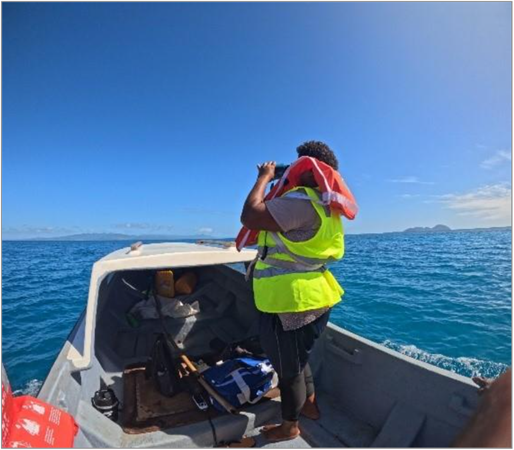
Female fish warden on the lookout. (Photo: WCS Fiji)
In response to these challenges, the communities of Bua, Bureta and Nakorotubu Districts are working with WCS-Fiji to undertake community surveillance and enforcement to enhance fisheries management and safeguard community-based MPAs. This initiative aligns with national priorities under the Ministry of Fisheries’ mandate to strengthen local governance of fisheries resources.
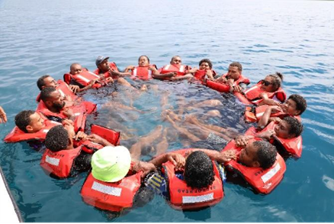
Community representatives participated in a structured training program encompassing the Boat Master Licence, Class 6 Restricted Licence, and Honorary Fish Warden certification in the districts.
The training, conducted in collaboration with the Maritime Safety Authority of Fiji and the Ministry of Fisheries, was designed to equip community members with a sound understanding of relevant legislation, including the Fisheries Act and associated regulations. The program also emphasized standard operating procedures for enforcement, documentation protocols, and mechanisms for reporting to relevant authorities. This foundational knowledge enables community Fish Wardens to conduct lawful patrols, identify breaches, and escalate incidents through official channels.
Boat master and fish warden training.
Following a participatory consultation process, each district established an Enforcement and Compliance group under the District Natural Resource Management Committees. These bodies are responsible for overseeing local enforcement activities and coordinating responses with government agencies. A 1-day workshop was convened to formalize these structures, clarify roles and responsibilities, and develop community-specific enforcement plans.
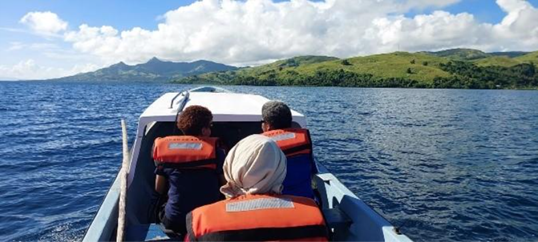
Initial patrols in Nakorotubu and Bua have already yielded results. Two separate incidents led to the apprehension of individuals engaged in unauthorized fishing activities. One case involved a fisher operating without the required permits in Nakorotubu waters, while another involved a licensed fisher violating the terms of their licence by fishing in non-consented areas in Bua. Both cases were processed and submitted to the Ministry of Fisheries for investigation and action. These enforcement successes have generated strong community awareness and deterrence effects. Word of the apprehensions spread rapidly, enhancing the effectiveness of the patrols and reinforcing community resolve to protect their marine resources.
Enforcement patrols in Nakorotubu. (Photo: WCS Fiji)
Community leaders have expressed strong support for the initiative. A Nakorotubu elder said: “I want to see the restoration of the Nakorotubu fisheries resources to how they were when I was young and ensure sustainable fishing methods are used at all times.” Similarly, Bua High Chief Ramakutu Nagagavoka emphasized the collective responsibility of the community -
“I want the Bua fishing grounds to be prosperous and healthy. Our communities must work together, even if it means holding our own villagers accountable through community patrols.”
Bua High Chief Ramakutu Nagagavoka
By combining Traditional Knowledge, local engagement, and practical support, Fijian communities are building climate resilience in their own way and demonstrating how protecting the environment can go hand in hand with securing sustainable livelihoods.
Validation Workshop to Support the Implementation of the WTO Agreement on Fisheries Subsidies in Fiji
This one-day workshop in Suva, Fiji, presented and discussed the findings of a self-assessment conducted to support Fiji’s preparation for implementing the World Trade Organization (WTO) Agreement on Fisheries Subsidies. It also helped identify final adjustments needed before completing the assessment, as well as plans for next steps toward domestic implementation.
November 18, 2025 9:00 am - 4:30 pm Fiji Standard Time
(By invitation)
Background
Overfishing remains a major global challenge, driven in part by harmful fisheries subsidies that increase fleet overcapacity and threaten marine ecosystems, food security, and the livelihoods of coastal communities. To address these impacts, the WTO Agreement on Fisheries Subsidies entered into force in September 2025, aiming to curb subsidies that contribute to overfishing and illegal, unreported, and unregulated fishing.
Recognizing the importance of supporting Pacific Island countries in preparing for ratification and implementation of the agreement, the Pacific Islands Forum Secretariat (PIFS) successfully mobilized funding from the Canadian Trade and Investment Facility (CTIF) to strengthen regional understanding of the disciplines. Under the first phase of this initiative in 2023, a regional report was produced to assist Pacific Island WTO members in assessing the implications of ratifying and implementing the agreement.
Building on this work, a second phase—led by IISD and supported by PIFS—is providing targeted assistance to Fiji and Papua New Guinea. This phase uses IISD’s self-assessment tool to evaluate government readiness, identify institutional and policy gaps, and determine where technical assistance and capacity enhancement are needed for effective implementation of the agreement.
About the Event
This validation workshop in Suva, Fiji, is a key activity under the project’s second phase. It aimed to present and discuss the results of the self-assessment, validate findings with government officials, and identify any adjustments needed before finalization. The workshop also provided officials with an opportunity to discuss follow-up actions and plan next steps toward domestic implementation of the WTO Agreement on Fisheries Subsidies.
Specifically, the workshop:
provided an overview of the agreement’s key disciplines;
introduced IISD’s self-assessment tool;
reviewed and validated findings on inventory, subsidy types, transparency requirements, key takeaways, and more; and
shared updates on ongoing negotiations of additional rules and outlined next steps.
November 25, 2024 9:00 am - March 24, 2025 3:25 pm GMT+12
(By invitation)
The AQUA-Pearl Stakeholder Workshop held in November 2024brought together key stakeholders to discuss nature-based aquaculture and its role in building climate resilience in Fiji. AQUA-Pearl, implemented by the International Institute for Sustainable Development (IISD) along with the Wildlife Conservation Society (WCS), J. Hunter Pearls, the Pacific Community (SPC), and Fiji’s Ministry of Fisheries, aims to enhance community resilience to climate change through nature-based approaches to oyster aquaculture and plays a role within the broader AQUADAPT network.
This report covers the key discussions, insights, and outcomes from the workshop:
Project Background: AQUA-Pearl (2024–2027) supports gender-responsive, community-led aquaculture in Fiji by integrating nature-based solutions (NbS).
Workshop Summary: Held in November 2024, the event introduced stakeholders to AQUA-Pearl and its alignment with biodiversity conservation, climate adaptation, and gender equality.
Discussions and Outcomes: Stakeholders explored the challenges and opportunities of NbS in aquaculture, policy alignment, and challenges to implementation.
Next Steps: Recommendations included more research on NbS, open data, and information on parallel initiatives; capacity building on seafood safety, good hygiene, and post-harvest handling; a whole-of-government approach for operationalizing and institutionalizing elements of the national aquaculture policy; and creating public–private partnerships.
There have been some clear changes in the climate of Fiji over recent years. This climate risk profile provides an overview of the Fiji's climate context, observed and projected climate change impacts, and a set of recommended NbS for adaptation actions and measures to promote gender-responsive and socially inclusive climate adaptation.
There have been some clear changes in the climate of Fiji over recent years, most notably temperature increases and an increase in the severity of storms; the climate is still expected to change in line with global projections.
The Government of Fiji has exemplified its commitment to climate adaptation through different policies and programs including launching its first NAP in 2018, passing the National Climate Change Act in 2021, and developing the Fiji National Climate Finance Strategy in 2022.
In Fiji, structural gender inequality is a driver of women's high degree of vulnerability to the impacts of climate change. Vulnerability within communities is not equally shared, with women and girls experiencing higher levels of vulnerability in terms of their livelihoods and well-being.
As Fiji continues to face the impacts of climate change, implementing effective adaptation strategies, including NbS for adaptation is essential. These initiatives should make a deliberate effort to adopt a gender-responsive and socially inclusive approach to their and implementation.
In Fiji, the number of cool nights has decreased, and the number of warm days has increased since 1942. There have been some clear changes in the climate of Fiji over recent years, most notably temperature increases and an increase in the severity of storms. More severe extreme weather events have also been observed in Fiji for decades, including more severe cyclones, droughts, and periods of excessive rainfall.
This climate risk profile has been developed as part of the Climate Adaptation and Protected Areas Initiative to illustrate the impacts of climate change, specifically within and around select protected areas in Fiji. The data in this report were derived from the climate risk assessments conducted in Fiji and rely on information collected from participatory engagement processes with communities, complemented by desk-based or secondary research.
This climate risk profile provides an overview of Fiji’s climate context, observed and projected climate change impacts, and a set of recommended nature-based solutions for adaptation actions and measures to promote gender-responsive and socially inclusive climate adaptation.
Can Behavioural Science Help Scale Climate Change Adaptation Solutions?
Applying behavioural science to climate change adaptation solutions might feel resource intensive, but research shows it is likely less costly than an intervention that doesn’t work.
August 19, 2024
Adapting to the impacts of climate change requires changing behaviour on an individual and a collective level—from how households make a living to how communities manage ecosystems, as well as how governments make investments. So why do we ignore the factors that drive how, when, and why people make decisions as we’re designing and implementing climate change adaptation solutions? IISD and Rare’s new report illustrates how behavioural science can help to question and reframe our assumptions about people’s decision making while supporting us in designing interventions that are grounded in a greater understanding of the psychological, social, and structural drivers of human actions.
The Challenge of Understanding People
Several factors prevent countries from implementing and accelerating climate change adaptation solutions. Lack of financial resources and the uncertainties associated with future climate risks are just two of them. But these aren’t the only barriers. Specifically, the psychological and socio-cultural drivers of behaviour are often left unaddressed.
In other words, we ignore the factors that drive how, when, and why people make decisions and take action when designing and implementing adaptation solutions.
Scientific bodies like the Intergovernmental Panel on Climate Change (IPCC), in its Assessment Report Six (IPCC, 2022), recognize the importance of understanding the behavioural dimensions of climate change adaptation. However, in practice, the psychological and socio-cultural factors that influence the adoption of climate change adaptation solutions are often under-researched or ignored.
This is a major hurdle, considering that adapting to the impacts of climate change requires changing behaviour on both an individual and a collective level—from how households make a living to how communities manage their ecosystems, as well as how governments make investments.
Tackling behaviour directly can feel quite complex. First, various historical, politico-economic, socio-cultural, and psychological factors can shape people’s decision-making processes.
Second, people’s actions are situated within a decision-making system comprised of multiple actors, including governments, development partners, civil society organizations, the private sector, communities, and individuals—all facing unique incentives.
Third, our understanding of how people make decisions is often based on assumptions, which leads to ineffective interventions.
Conscious and unconscious processes—such as habits, emotions, biases, and social influence—impact people’s decisions. This means that even when people understand the relevance of a specific solution and shift their attitudes or intentions toward it, this often is not enough for them to adopt the solution.
Most interventions designed to change behaviour tend to overlook such insights, so applying behavioural science to the design and implementation of climate change adaptation initiatives could help us address past failings and improve the acceptability, effectiveness, and sustainability of solutions.
Aerial view of Naveiveiwali village and Wainibuka river and riverbank.
Case Study on Ecosystem-Based Adaptation in Fiji
To pilot and apply a behavioural science lens to a climate change adaptation solution, we focused on a past ecosystem-based adaptation (EbA) project implemented by the Fijian government.
EbA, also called nature-based solutions for adaptation, is an approach for adjusting to the impacts of climate change that focuses on protecting, restoring, and enhancing ecosystem services, all while improving communities’ well-being. The Fijian government is seen as a leader on this topic because it recognizes the need to prioritize EbA in key strategic policy documents.
Between 2019 and 2020, the Fijian government implemented a project that supported communities vulnerable to riverine erosion and flooding by giving them vetiver grass to plant along the riverbanks. Vetiver is a non-invasive species of grass with a fast-growing and deep root system that helps stabilize the soil. It is a robust solution to manage climate uncertainties because of its tolerance to both prolonged drought and waterlogging.
The government deployed a one-off intervention in the villages that did three things: i) they provided free vetiver seedlings through a new vetiver grass nursery at the provincial level; ii) they provided payment for ecosystem services, meaning that each village—through existing community groups—got paid to collectively plant vetiver along the riverbank; and iii) government officials hosted awareness-raising sessions on vetiver planting targeted at men and young people.
However, in 2023, 3 years after the communities had planted the seedlings, there had been no maintenance of the vetiver along the riverbanks in any of the villages.
Our research, therefore, sought to explore the behavioural variables that could have contributed to (or impeded) the adoption of vetiver as an erosion-reducing practice among target communities. We selected three rural Indigenous Fijian communities that benefited from this project and a fourth one that did not receive support as a comparison site.
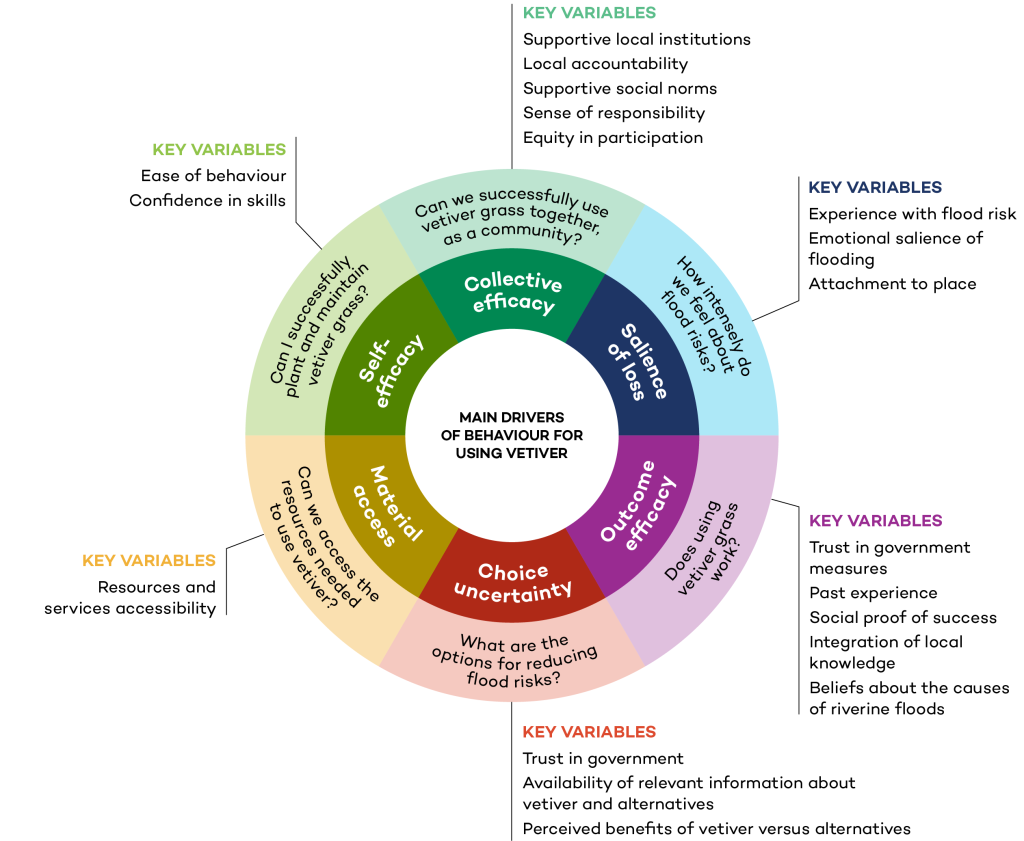
Six Main Drivers of Adoption
Our research found that the key drivers influencing vetiver grass adoption for riverbank rehabilitation in selected communities in Fiji are complex but identifiable.
Many factors likely influence decision making around vetiver grass adoption at the household and community levels. Our analysis revealed that the six main drivers influencing the adoption (or non-adoption) of vetiver grass for riverbank erosion control against flooding were
salience of loss: whether villagers feel strongly about the negative impacts that erosion and flooding have on their lives
choice uncertainty: whether villagers are certain about the options available to them to reduce erosion
collective efficacy: whether villagers feel their community can plant and maintain vetiver to reduce erosion
self-efficacy: whether villagers feel they personally can successfully plant and maintain vetiver grass to reduce erosion
material access: whether villagers feel they can easily access and afford vetiver
We found that together, these drivers worked in concert to push and pull decision-makers toward or away from adopting and maintaining vetiver grass.
Each of these variables was identified from the data and further broken down into its constituent factors. The first two examples listed are salience of loss and choice uncertainty.
Salience of loss refers to the emotional and cognitive responses individuals had toward flood risks and riverbank erosion. When discussing vetiver, several aspects repeatedly surfaced. Participants frequently mentioned experience with flooding and erosion, noting that riverine erosion and flooding seemed to be becoming more frequent and intense. One respondent noted, “The floods have become more often than normal [and] more intense, and the currents are way more swift and bold now that it eats away at our riverbanks every time it floods.”
Another said, "We are very concerned that our village is going to be washed off one day. Flooding is occurring more regularly now as the river has become shallow and wider in some places where erosions have happened. The erosion keeps moving inland; we are concerned that one day it is going to take away houses too."
These comments tied into the emotional salience of flooding, which was also a recurring theme. Participants expressed strong negative emotion related to the impact of riverine erosion and flooding on their lives and those of others.
What was particularly striking was the way participants referred to the loss of land as a direct dilution of their cultural identity. Their attachment to place was obvious, with respondents' cultural identity being closely linked to their land, including the riverbank, heightening their concern about erosion.
One participant said, “[The riverbank] is also a place where we rest and talk about our issues, it’s a bonding place for us women while we’re washing, fishing, or harvesting vegetables,” while another respondent mentioned, “The riverbanks are eroding fast, and we are losing land. Land is an important inheritance culturally as the size of the land depicts the strength of the clan.”
Choice uncertainty involved the perceived lack of clear information about the options available for reducing flood risks. Participants often wondered what other solutions might be available for the community to use. This uncertainty can diminish people’s sense of agency, and respondents felt they lacked information about the choice set available to them and their outcomes. Community members weren’t clear on all the options at hand to help fight erosion or how these options compared to one another—or even to doing nothing. As one participant said, "We want to continue with vetiver but also want to know what other interventions are out there that we can probably choose from."
In scenarios where such decisions could reduce farming land’s immediate potential, combined with our human propensity for preferring known, predictable risks over unknown, ambiguous ones, this uncertainty could be particularly problematic.
The semi-structured interviews revealed that approximately 43% of respondents expressed uncertainty regarding the relative effectiveness of both hard and natural infrastructure. Opinions were evenly split on whether natural infrastructure like vetiver is more effective than hard infrastructure like walls. It was the same with the benefits of vetiver, with only half of respondents (48%) believing that planting vetiver would benefit them personally. Qualitatively, respondents also noted a perceived lack of relevant information on vetiver itself, with comments such as, "[We've received] no trainings/awareness on vetiver grass and its benefits," and "We've heard about it during the community planting program but there was no training or awareness done."
Trust in authorities was another recurring theme, particularly related to how much faith villagers put in key messengers and their information.
Lessons in Addressing Climate Change Adaptation by Understanding People
This case study illustrates how behavioural science can help to question and reframe our assumptions about people’s decision making and support us in designing interventions that are grounded in a greater understanding of the psychological, social, and structural drivers of human actions.
Behavioural science research shows that a combination of interventions addressing multiple drivers is often required to drive and sustain collective action, and a singular intervention is unlikely to address all variables driving decision making at the household and community levels.
This means that while each of the six drivers is important to support vetiver grass adoption, addressing each variable in a siloed manner will likely not be sufficient to bring sustained change.
In this case, the Fijian government and development partners need to craft interventions that specifically target and address the drivers of vetiver grass adoption identified through research, rather than relying on the assumptions that we all too often fall prey to, for example, that more information will lead to behaviour change. In doing so, they can then test and validate whether those interventions lead to the psychological, social, or structural changes predicted to result in greater adoption (and to identify how a change in a specific driver influences behaviour downstream).
More broadly, expanding the application of behavioural science into the realm of climate change adaptation calls for establishing new partnerships between climate change adaptation experts and behavioural scientists.
Behavioural scientists are already engaging in many fruitful areas of collaboration, such as on financial, public health, and food choice decision making.
Our analysis highlights how important—and urgent—it is for climate change adaptation professionals to also engage with behavioural scientists early, at the start of project formulation rather than in the diagnosis phase, to ensure that initiatives are informed by a deep understanding of human behaviour.
This is alongside real and considered community engagement, which is essential to understanding current behaviour and what it means for enhancing resilience and consideration of the adoption of EbA solutions within the broader context of climate change adaptation and development. In this case, the focus on vetiver adoption at the local level should not overlook the broader and more systemic issues that are causing riverbank erosion, likely driven by unsustainable development such as deforestation, poor road drainage systems, and gravel extraction from the riverbed. Climate change is exacerbating the negative impacts of these factors on communities that are dependent on riverine ecosystems for their livelihoods, and focusing solely on changing behaviour at the household and community levels is not enough to effectively address climate change adaptation.
Finally, applying behavioural science can feel fairly resource intensive, and identifying ways to make this cost-benefit ratio relevant to policy-makers might be necessary if we are to scale climate change adaptation solutions more globally. Understanding current behaviour, and what determines behaviour, often requires collecting and analyzing multiple rounds of primary data at the household and community levels. However, this approach is likely a lot less costly than having an intervention not work, as it’s clear that failure to properly engage with communities in understanding and testing the factors that influence their climate change adaptation behaviour can backfire.
Biodiversity Is in Crisis—Here's one way to fix it
A growing movement of projects and partnerships is using locally driven and gender-responsive nature-based solutions to address the twin crises of climate change and biodiversity loss. Scaling up this work to match the urgency and reach of the crises will be a challenge—but it’s one we must embrace.
May 21, 2024
The Rwenzori Mountains loom large over the surrounding scenery in southwestern Uganda. Here, snowmelt and rainwaters flow through alpine meadows and forests of otherworldly flora, including giant lobelia and heather taller than a person, to provide the source waters of the Nile. Moving south, the lakes, rivers, and grasslands of Queen Elizabeth National Park are home to not only elephants, buffalo, and hippopotami but also vast herds of kob—and the tree-climbing lions that prey on them.
Standing within these beautiful settings, you could be forgiven for thinking that nature is thriving. However, these exceptional places, inscribed as part of our collective natural heritage by UNESCO, are increasingly islands of ecosystem health in fragmented landscapes and seascapes beset by outside pressures.
The Sixth Extinction
It is a well-known story, and the headlines are often dire. Rates of species extinction and ecosystem degradation are accelerating; according to the 2019 Global Assessment Report by the Intergovernmental Science-Policy Platform on Biodiversity and Ecosystem Services (IPBES), 1 million animal and plant species are currently threatened with extinction, many within decades, unless urgent, transformative action is taken. Abundance has plummeted for many of those species not yet gone; WWF’s 2022 Living Planet Report notes an average decline of 69% in the relative abundance of monitored wildlife populations around the world between 1970 and 2018. The scale of the problem is so large that it is now commonly referred to as the sixth extinction: the loss of an unusually large number of species in a short time, driven by human activities.
Compounding Crises
IPBES cites five anthropogenic factors as key drivers of this crisis: land- and sea-use change; direct exploitation of natural resources; climate change; pollution; and invasive species.
Nature has a foundational role in global health, food systems, livelihoods, climate adaptation, economies, and security. Thus, the acceleration of nature loss, when considered in the context of rising demands from growing populations for both ecosystem services and natural resources, means that avoiding further degradation or loss of biodiversity and ecosystem services should be an increasingly important consideration for governments, communities, and the private sector.
This crisis is unfolding in the context of rising global temperatures. The climate crisis is having a significant impact on the natural world. While land- and sea-use changes are currently the greatest drivers of nature loss, a failure to limit planetary warming to 1.5°C will result in climate change becoming the dominant cause of global biodiversity loss and ecosystem degradation in the coming decades.
Climate change is disrupting natural feedback loops and altering the habitats and ranges of various fauna and flora. Its impacts also undermine the delivery of ecosystem services, harming human lives and livelihoods and compromising efforts to eradicate poverty and hunger and provide safe water for billions of people. Achieving the United Nations Sustainable Development Goals, alongside the Paris Agreement and the Kunming-Montreal Global Biodiversity Framework, will depend on a coordinated response to these deeply connected emergencies.
How Can Nature-based Solutions Build Climate Change Resilience?
But while climate change and biodiversity loss often act to reinforce one another, so do effective climate change adaptation and nature protection. Nature-based Solutions (NbS) have emerged as an integrated concept beyond climate change adaptation and traditional conservation. NbS may have the potential to tackle multiple societal challenges, such as protecting, managing, and restoring biodiversity and ecosystems. Their services are increasingly seen as an effective way to address some of the shared root causes and impacts of the biodiversity and climate crises.
In Belize, Fiji, and the Greater Virunga and Kavango-Zambezi (KAZA) landscapes in sub-Saharan Africa, NbS are being rolled out to increase the resilience of both communities and ecosystems to climate change. Through the Climate Adaptation and Protected Areas (CAPA) Initiative, IISD is working with the Wildlife Conservation Society, the World Wide Fund for Nature, and local partners and communities within these spaces to conserve, protect, restore, and sustainably manage protected areas.
More than 50 km from the mainland of Belize, Glover’s Reef atoll lies just inches above the deep blue waters of the western Caribbean. Glover’s is a critical link in a chain of reefs and islands that form the largest barrier reef in the Western Hemisphere. Here, IISD and the Wildlife Conservation Society are working to strengthen the reef's health and its ability to support local livelihoods, remain a suitable habitat for marine species, and provide coastal protections against extreme weather events.
Half a world away, in southwestern Uganda, lies what is arguably Africa’s most biodiverse landscape. The Greater Virunga Landscape stretches along the shared borders of Uganda, Rwanda, and the Democratic Republic of Congo—a mosaic of mountains, savannas, rivers, lakes, swamps, tropical rainforests, and volcanoes. Here, conservation interventions implemented by the World Wide Fund for Nature and partners focused on reforestation, invasive species removal, land restoration, and nature-based livelihoods will help build the resilience of three national parks (Rwenzori Mountains, Queen Elizabeth, and Bwindi Impenetrable) and the communities that surround them to rising temperatures, increased flood risk, landslides, and erosion. Even more work is happening under the project in the KAZA landscape and in Fiji to support reforestation, restock wildlife, promote sustainable fisheries, and improve flood mitigation, among other activities.
The threats facing these ecosystems—and, by extension, the conservation practitioners that manage and support them; the communities that sustain and depend on them; the flora and fauna that make them indispensable—can often seem insurmountable. But there is hope. CAPA is one small part of a growing movement of projects, partnerships, and approaches using NbS to simultaneously address these two existential emergencies. Scaling up this work to match the urgency and reach of the crises will be a challenge, but it is a challenge we must embrace.
To learn more about the CAPA Initiative, please visit www.iisd.org/capa.
The AQUA-Pearl project will help communities in Fiji build their resilience to climate change through nature-based approaches to oyster aquaculture.
AQUA-Pearl works with local fisher communities, women, national and local authorities, and the private sector to scale up gender-responsive and inclusive, community-led, nature-based approaches to aquaculture in Fiji. The project is implemented by IISD along with the Wildlife Conservation Society, the Pacific Community, and J. Hunter Pearls, in cooperation with Fiji’s Ministry of Fisheries. It is supported by the International Development Research Centre (IDRC) and Global Affairs Canada.
The AQUA-Pearl project addresses the intertwined critical challenges of climate change, biodiversity loss, and poverty by
exploring current and future gender and climate vulnerabilities, risks, and opportunities in the aquaculture sector;
integrating community values and preferences;
enhancing community and ecosystem resilience to climate change;
identifying entry points to aligning fisheries and aquacultural development plans with national adaptation, biodiversity conservation, and development priorities (including gender and development priorities);
unpacking the role of the private sector and other stakeholders in nature-based aquaculture;
fostering knowledge sharing and capacity building among civil society organizations, private sector entities, and national and local authorities from Fiji and other Pacific Island states.
The project builds on a previously piloted community-led oyster aquaculture project and is part of the Nature-based Climate Solutions in Aquacultural Food Systems in Asia-Pacific initiative (AQUADAPT). This 4-year initiative, co-funded by IDRC and Global Affairs Canada, aims to drive research action toward inclusive, nature-based aquaculture solutions and a better understanding of how such solutions can contribute to climate change adaptation, biodiversity conservation, and food security in Southeast Asia and the Pacific region.
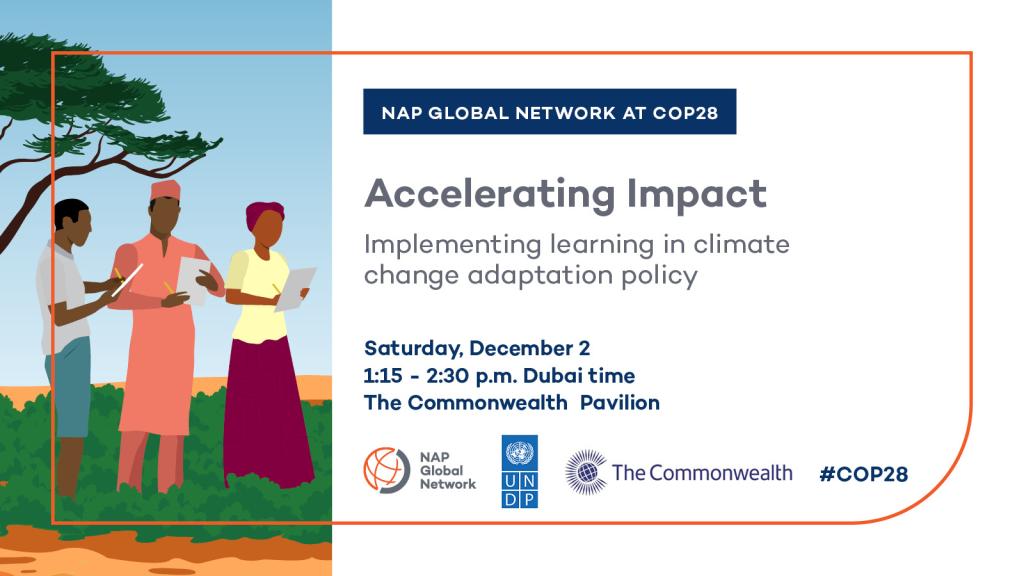
COP 28 Side Event | Accelerating Impact: Implementing learning in climate change adaptation policy
December 2, 2023 1:15 pm - 2:30 pm GST (GMT+4)
The Commonwealth Pavilion
(Open to public)
The Paris Agreement emphasizes learning and ambition through initiatives like the Global Stocktake and the Global Goal on Adaptation. These should bolster national monitoring, evaluation, and learning (MEL) systems that influence global objectives and align with national plans like NAPs and NDCs. However, learning is frequently sidelined in policy and MEL cycles. Active efforts are required to foster learning in national policies, and sharing notable examples is crucial.
This panel will bring together governments from Commonwealth countries—including Belize and Fiji—to examine what governments and other actors have learned from implementing climate adaptation in the context of NAP processes, the factors that drove or contributed to learning, and challenges in knowledge.